
PIRATE BORG — A Review of the Dark Caribbean’s Grim Art-Punk RPG


Pirate Borg is a game that doesn’t just invite you into its world, it drags you below deck, slams the hatch shut, and lets the creaking timbers and distant screams tell you everything you need to know. It’s a rules-light OSR RPG steeped in grime, rot, and salt, a feverish reimagining of the Golden Age of Piracy where the Caribbean has been twisted into a supernatural wasteland. The Dark Caribbean is a place where undead horrors drift through fog-choked waters, colonial powers crumble under eldritch pressure, and pirate crews cling to life with rum-soaked desperation. The setting is thick with tension and decay, and the book wastes no time establishing a tone that is equal parts swashbuckling adventure and apocalyptic nightmare.

The worldbuilding is one of the game’s strongest pillars. The Dark Caribbean feels lived-in, cursed, and constantly on the brink of collapse. Islands are sketched with just enough detail to spark imagination while leaving ample room for improvisation. The inclusion of ASH, a drug made from the burned remains of undead creatures adds a layer of grotesque economic and cultural texture that instantly sets the region apart from traditional pirate fiction. It’s a world where the supernatural isn’t a garnish; it’s the engine driving conflict, corruption, and survival. Every port, every shipwreck, every faction feels like it’s hiding a secret that could doom or enrich a crew depending on how recklessly they chase it.
Mechanically, Pirate Borg builds on the bones of MÖRK BORG but expands them in ways that feel natural to the pirate fantasy. Character creation is fast, chaotic, and dripping with personality. Rolling stats, gear, curses, and quirks takes minutes, and the eight available classes range from grounded archetypes like Buccaneers and Rapscallions to stranger, more supernatural options like the Undead Soul. The game encourages players to embrace the messiness of pirate life as characters are flawed, unlucky, and often doomed, but they’re also capable of sudden bursts of heroism thanks to the Devil’s Luck mechanic. This push-your-fortune system gives players just enough agency to feel daring without undermining the game’s lethal edge.
Character Creation
Roll 3d6 for five stats: Strength, Agility, Toughness, Spirit, and Presence (with Spirit replacing Presence as the spellcasting stat).
Choose or roll from eight classes, ranging from grounded archetypes (Buccaneer, Rapscallion) to supernatural oddities (Undead Soul).
Random tables determine gear, quirks, curses, and even hats.

Combat is fast, brutal, and player-facing, keeping the GM focused on pacing and atmosphere rather than dice arbitration. Encounters rarely drag; instead, they erupt, escalate, and resolve with cinematic intensity. Naval combat is a standout feature, offering a surprisingly robust yet intuitive system for ship-to-ship battles. Ships have stats, conditions, and upgrade paths, and the roles players take aboard, from captain to gunner to navigator matter in ways that feel both thematic and mechanically satisfying. It’s one of the rare RPGs where naval combat doesn’t feel like an afterthought but a developed core experience.
Devil’s Luck is the game’s push-your-fortune mechanic, a small reservoir of narrative power that lets players cheat death or turn a disaster into a moment of triumph. You can use it to reroll a failure, reduce incoming damage, or turn a near-death moment into a cinematic escape. It’s a brilliant tension valve. It doesn’t make the game less lethal, it just gives players a chance to go out in style.
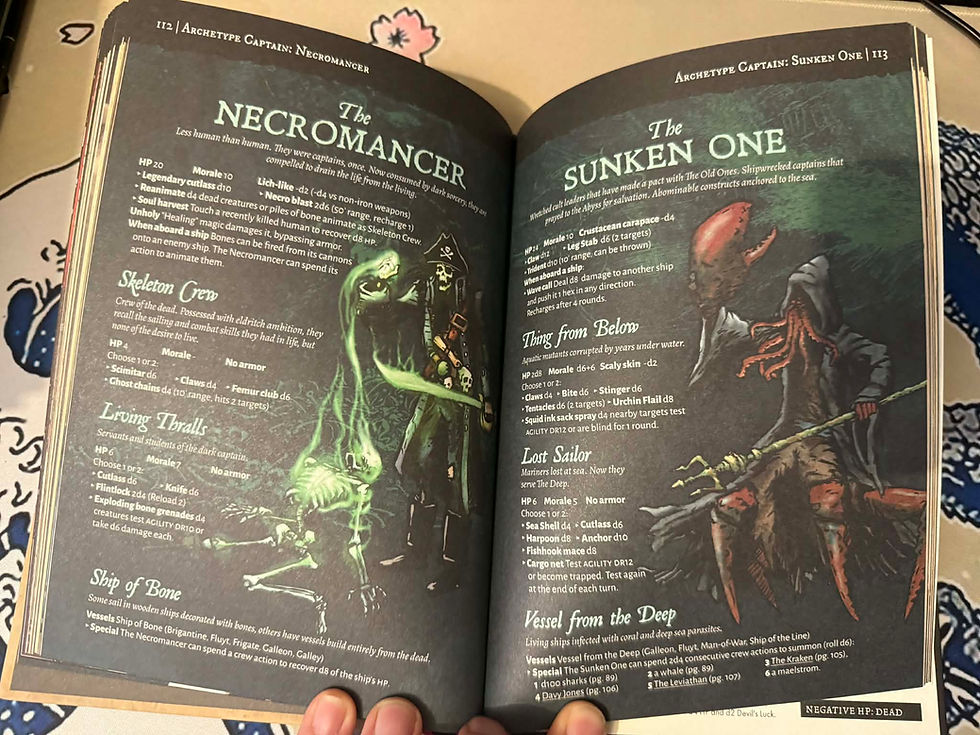
Where Pirate Borg truly shines is in its GM tools. The book is a treasure chest of generators, tables, and improvisational aids. Need an island? Roll for it. Need a ship, a treasure map, a weather pattern, a cursed artifact, or a rumour whispered in a tavern? It’s all there, ready to be conjured in seconds. This makes the game ideal for sandbox play, where the GM can build an entire campaign on the fly with nothing but the book and a handful of dice.
The book is a GM toolkit disguised as a rulebook, packed with:
island generators
ship generators
treasure map creators
weather tables
encounter tables
faction hooks
curses, rituals, and supernatural events
You can run an entire campaign with nothing but the book, a handful of dice, and a willingness to embrace chaos.

Curse of Skeleton Point is the beating, blackened heart of Pirate Borg’s introductory experience. It's a sprawling, open-ended mini‑campaign that drops players into the Dark Caribbean with no handrails, no guarantees, and no promise of survival. Rather than a linear adventure, it’s a sandbox of escalating dread, a cluster of islands riddled with undead horrors, cursed ruins, rival crews, and environmental threats that feel like they’re actively trying to kill you.
The campaign begins with a simple premise: the crew arrives in a region plagued by strange disappearances, ghostly sightings, and whispers of a curse emanating from the infamous Skeleton Point. But the brilliance of the design is that nothing is fixed. The adventure is built from modular locations, each island, shipwreck, cave system, and settlement can be explored in any order, and each one contains its own micro‑stories, dangers, and secrets. This structure encourages players to chart their own course, make their own mistakes, and stumble into horrors they were absolutely not prepared for.

The climax of Curse of Skeleton Point is flexible, shaped by the crew’s choices, alliances, and failures. It can end in a desperate escape, a doomed last stand, a triumphant cleansing of the curse, or a catastrophic unleashing of something far worse. The adventure never forces a “correct” ending; it simply provides the powder keg and lets the players light the fuse.
Visually, Pirate Borg is a metal album masquerading as an RPG. The art is grimy, high-contrast, and aggressively stylized, with layouts that feel torn from cursed nautical charts or the margins of a sailor’s fever journal. Typography shifts, bleeds, and snarls across the page, reinforcing the game’s anarchic energy. It’s not just a rulebook; it’s an artifact. The design choices occasionally sacrifice clarity for style, but the overall effect is so cohesive and evocative that it’s hard to fault the ambition. The book feels alive — or at least undead.

At the table, the game is a blend of dark humour, survival horror, and swashbuckling chaos. Characters lose limbs, gain curses, snort undead ash, mutiny, drown, resurrect, and die again. The tone is grim but not joyless; there’s a black comedy running through everything, a sense that the world is ending but the rum is still flowing. It’s a game that rewards reckless creativity and embraces the idea that failure can be just as fun, if not more so than success.
That said, Pirate Borg isn’t without its rough waters. The art-punk layout, while gorgeous, can occasionally hinder quick reference during play. The game is still rules-light, but the added subsystems inc naval combat, rituals, ASH effects make it denser than other Borg titles, which may surprise players expecting pure minimalism. And the tone, while brilliantly executed, is niche; tables looking for heroic piracy or light-hearted adventure may find the grimdark aesthetic overwhelming.

Pros
Incredible atmosphere and worldbuilding that reimagines piracy through a grimdark, supernatural lens.
Fast, lethal, and engaging mechanics that encourage improvisation and cinematic play.
Outstanding naval combat system that feels both thematic and mechanically satisfying.
A treasure trove of GM tools including generators, tables, and sandbox-friendly systems.
Striking art and layout that reinforce the game’s tone and identity.
Quick character creation that supports high-lethality, high-chaos play.
Cons
Art-punk layout can hinder readability, especially mid-session.
More complex than other Borg titles, which may surprise OSR purists.
No pre-generated characters, making onboarding slightly slower for new groups.
Very specific tone that may not appeal to tables seeking lighter or more traditional pirate adventures.
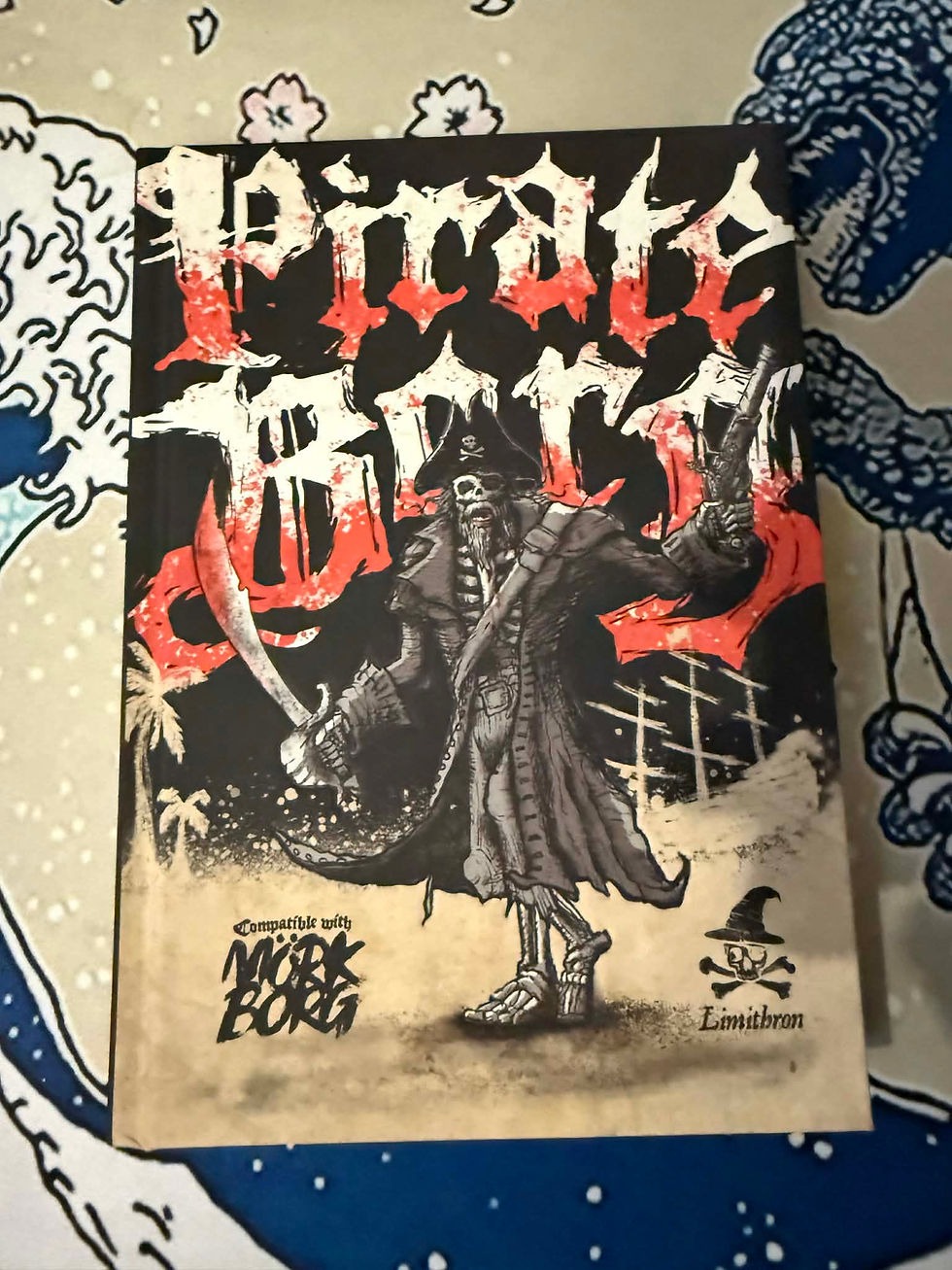
Pirate Borg is a triumph of atmosphere, design, and OSR philosophy, a game that knows exactly what it wants to be and commits to that vision with ferocity. It’s stylish, brutal, imaginative, and endlessly re-playable, offering a Dark Caribbean that feels both richly detailed and ripe for improvisation. The combination of lethal mechanics, evocative worldbuilding, and robust GM tools makes it one of the most distinctive RPGs in recent years. It’s not flawless, and its niche tone won’t suit every table, but for those who crave grimdark piracy infused with supernatural dread, it’s an unforgettable voyage.
XPN Rating: 4.5 out of 5 (GOLD)

Pirate Borg is available now!


Comments