
Skautfold: Moonless Knight - Xbox Review


Skautfold: Moonless Knight feels like a curious artefact from another era. It's part gothic action‑RPG, part experimental Metroidvania, and unmistakably rooted in the eccentric, lore‑dense universe that the Skautfold series has been quietly building for years. Developed by Pugware and originally released on PC before making its way to consoles, this chapter shifts the series into a top‑down perspective and leans heavily on its signature blend of cosmic horror, alternate‑history politics, and grim, blood‑soaked atmosphere. It’s a game that clearly aims high, layering its combat systems and worldbuilding with ambition, even if the execution doesn’t always match the scope of its ideas.

The game opens with a strong hook: you play as Gray, a knight dispatched on a diplomatic mission that quickly spirals into a cosmic crisis. The setting of a hybrid of feudal Japan and eldritch corruption should be fertile ground for atmosphere. And at first, it is. The Oda Imperial Palace is a labyrinth of ornate halls, shadowed chambers, and lurking monstrosities, all hinting at a world where political intrigue and cosmic dread bleed together.
But the deeper you go, the more the cracks show. The writing is riddled with tonal inconsistencies and awkward phrasing, often breaking immersion at the exact moments it tries to build tension. Script misspellings, fragmented sentences, and sudden shifts into modern slang make the narrative feel unpolished and distract from the otherwise compelling premise. The result is a story that feels like it should be gripping, but instead becomes something you observe from a distance where you are interested, but never fully invested.

Combat is where Moonless Knight tries hardest to stand out. The Guard System where both you and enemies have separate Guard and HP bars creates a rhythm built around timing, spacing, and counterplay. Perfect blocks, feints, and parries can turn the tide of battle, and in theory, the system rewards mastery and patience.
However, the execution often feels sluggish. Attacks come out slowly, movement lacks fluidity, and the controls never quite achieve the responsiveness needed for a timing‑based combat system. The combat feels stiff, awkward, or outright frustrating, especially when facing groups of enemiesmaking the lack of mobility become a real problem. Even players who eventually “get” the system may find themselves fighting the controls as much as the enemies.

As a Metroidvania, Moonless Knight offers a semi‑open structure with relics that unlock new traversal abilities like grappling hooks, light sources, and strength upgrades. On paper, it’s a familiar but effective formula but unfortunately in practice, exploration often feels sterile and overly mechanical.
The palace is large, but not particularly rewarding to explore as well. A lack of secrets, meaningful discoveries, or environmental storytelling, leaves traversal feeling like a checklist rather than an adventure. Backtracking is frequent, and relic usage can be unintuitive, with some mechanics hidden in menus rather than taught naturally.
There are moments of charm however with occasional oddities, hidden characters, or quirky touches but they’re too sparse to elevate the overall experience.
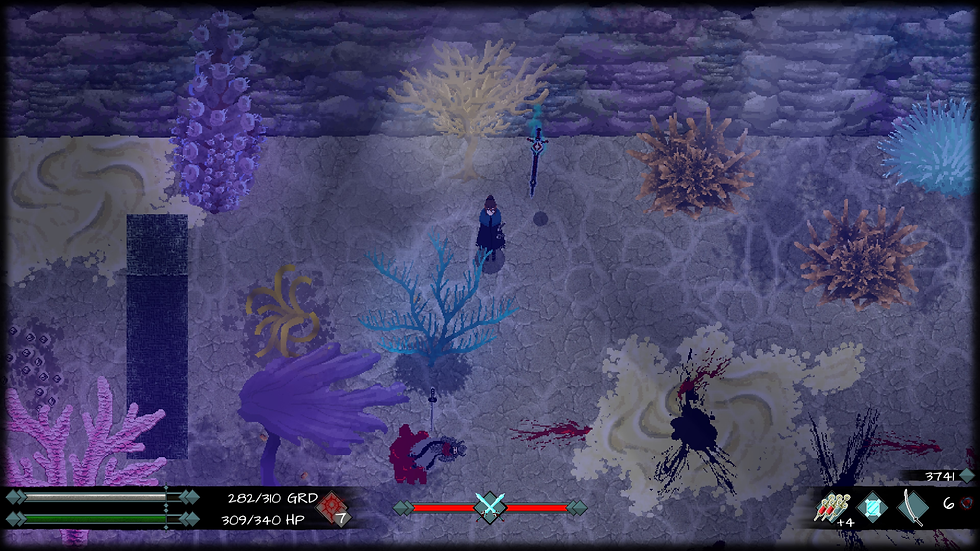
Visually, the game has a distinctive identity: jagged pixel art, stark contrasts, and a grim, oppressive tone. Some environments look striking, especially deeper in the palace where the cosmic elements seep through. But the top‑down perspective and inconsistent shading can make areas look flat or confusing, with walls and floors blending together in ways that hinder readability .
Animations are another sticking point. They come across rather stiff or sluggish, contributing to the overall sense of heaviness in movement and combat. Luckily the soundtrack fares better as it's moody, atmospheric, and fitting for the setting, although it rarely becomes memorable and you wont remember any stand out tracks.

Pros
Atmospheric, distinctive setting blending cosmic horror, alternate history, and gothic decay into a world that feels genuinely unusual.
Ambitious Guard‑based combat system that rewards timing, patience, and mastery when it finally clicks.
Memorable boss encounters that stand out as the game’s most focused and engaging moments.
Moody soundtrack and strong tonal identity, giving the game a sense of place even when the writing falters.
Compact runtime that suits players who enjoy shorter, self‑contained Metroidvania‑style adventures.
Runs smoothly on Xbox, with stable performance and no major technical issues.
Cons
Combat feels stiff and sluggish, undermining the precision the Guard System demands.
Writing is inconsistent, with awkward phrasing and tonal shifts that break immersion.
Exploration lacks reward, offering few secrets, sparse environmental storytelling, and repetitive backtracking.
Animations and movement feel dated, making traversal and combat feel heavier than intended.
Top‑down perspective can hinder readability, with environments sometimes blending together visually.
Difficulty spikes feel uneven, often caused by control limitations rather than intentional challenge.

Skautfold: Moonless Knight is a game of contradictions. It’s atmospheric but unpolished, ambitious but uneven, conceptually rich but mechanically clumsy. On Xbox, it runs smoothly enough, but the core issues like stiff combat, awkward writing, and uninspired exploration remain unchanged.
For players who enjoy dissecting flawed but fascinating indie titles, there’s something here worth experiencing. The world is strange, the systems are unique, and the tone is unlike most modern Metroidvanias. But for anyone seeking tight combat, refined exploration, or a cohesive narrative, this may feel more like a curiosity than a recommendation.
XPN Rating: 3 out of 5 (SILVER)

Skautfold: Moonless Knight is available now!


Comments