
Resonance: A Plague Tale Legacy - Review


Resonance: A Plague Tale Legacy on Xbox Series X/S is a confident, atmospheric prequel that reshapes what a Plague Tale game can be. The shift from stealth-driven tension to full-bodied action-adventure is bold, but it works largely because Sophia, now the centre of the narrative, is compelling enough to carry the weight of the franchise’s pivot. The result is a brisk, visually stunning, emotionally charged adventure that blends Greek myth, personal trauma, and Asobo’s trademark environmental artistry into something that feels both familiar and refreshingly new.
Resonance positions Sophia not just as a side character elevated to protagonist, but as someone whose entire life has been shaped by captivity, loss, and a strange, mythic pull she doesn’t understand. The game opens with her imprisonment as a child, a formative trauma that becomes the emotional spine of the narrative. These early sequences are claustrophobic, oppressive, and deliberately disorienting, grounding you in her fractured sense of self.

The story then jumps forward to Sophia as an adult, already hardened, already carrying the scars of what was done to her. But the game doesn’t treat her toughness as a given, it treats it as a consequence. Her anger, her impulsiveness, her refusal to trust anyone fully… all of it is rooted in those early years. Resonance is, at its core, a character study.
The most distinctive narrative device is Sophia’s connection to Theseus. These aren’t simple flashbacks , they’re lived experiences, moments where she slips into the mythic past and sees the wo through his eyes. The game uses these sequences to blur the line between history, legend, and psychological projection.

Theseus becomes a mirror for Sophia. His trials echo her own. His burdens reflect her guilt. His victories hint at the strength she hasn’t yet realised she possesses. It’s clever, because it lets the game explore themes of legacy and destiny without ever feeling like it’s abandoning the grounded emotional tone the series is known for.
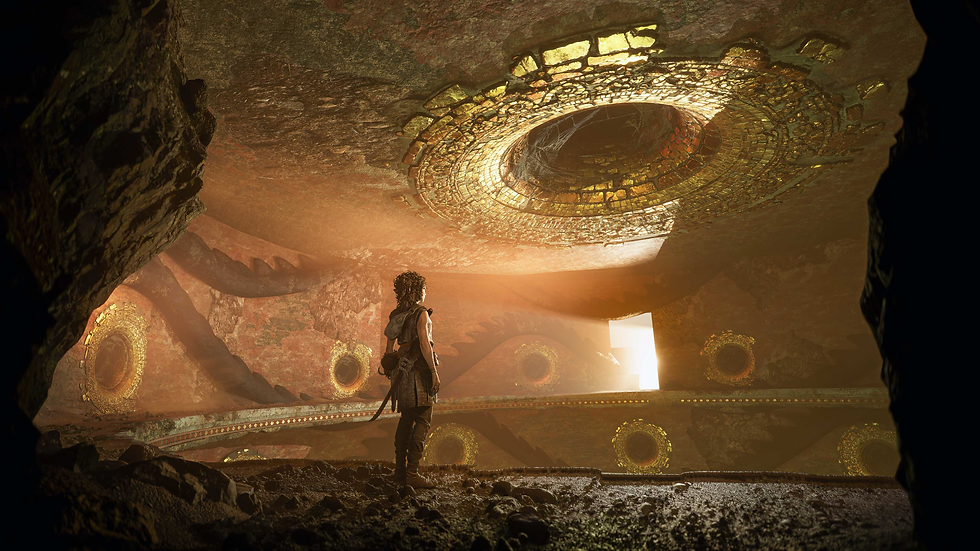
What truly elevates the story is the world itself. From Venetian carnivals to Aegean beaches and cyclopean ruins, the environmental design is breathtaking. Light is used as a narrative device, twilight marking the end of innocence, dawn signalling hope. It’s a game that frequently makes you stop just to take in the scenery.

Resonance marks a dramatic shift from the stealth‑heavy tension of the earlier Plague Tale games. Sophia isn’t creeping through shadows or relying on improvised tools, she’s a close‑quarters fighter, and the entire combat system is built around her ferocity. Encounters are fast, punchy, and intimate. You’re constantly weaving between parries, dodges, and heavy strikes, reading enemy animations and committing to attacks with deliberate timing.
The health‑on‑kill mechanic adds a sharp risk/reward edge: you’re encouraged to stay on the offensive, because retreating or playing cautiously often leaves you more vulnerable. It’s a system that rewards momentum, but it can also punish hesitation harshly, especially during multi‑enemy encounters where spacing becomes everything.

The combat isn’t as deep or layered as modern action titles, but it has a tactile rhythm that feels satisfying. When it clicks, it’s exhilarating, a dance of aggression and precision. When it doesn’t, it can feel unforgiving, especially in late‑game sequences where enemy density spikes. Still, the game’s commitment to making Sophia feel powerful and physically present is one of its strongest mechanical choices.
Asobo’s visual craftsmanship is on full display. Resonance is gorgeous, lighting, set design, character detail, and mythic architecture combine into one of the studio’s most striking worlds. The soundtrack by Olivier Derivière is equally powerful, heightening emotional beats and combat tension with ease.

Where Resonance truly shines is in its exploration. The game leans heavily into large, sculptural environments, towering ruins, labyrinthine caverns, sun‑drenched cliffs, and ancient mechanical structures that feel like they belong in a mythological epic. Traversal is fluid and cinematic, with climbing, sliding, balancing, and environmental interaction woven into long, satisfying sequences. There’s a clear lineage here: if A Plague Tale was once a stealth‑drama, Resonance borrows from classic Tomb Raider and Prince of Persia, embracing spectacle and scale.
On Xbox Series X, the experience is smooth and cinematic. On Series S, however, technical hiccups like stutter, tearing, and pop‑in can break immersion. The underlying game remains strong, but the hardware struggles to keep up with its ambition.

Pros
Stunning environmental design and lighting
Strong emotional narrative with mythological depth
Sophia is a compelling, fully realised protagonist
Excellent soundtrack and sound design
Clever puzzles and memorable exploration sequences
Cons
Combat can feel repetitive and overly punishing
Linear structure limits replayability
Technical issues on Xbox Series S
Some predictable plot beats and uneven dialogue
Resonance: A Plague Tale Legacy is a bold reimagining as an action-forward, myth-infused prequel that expands the universe without losing its emotional core. It’s not as mechanically deep as some action titles, and combat can be uneven, but its storytelling, atmosphere, puzzles, and audiovisual craft make it a standout entry in the franchise.
XPN Rating: 4 out of 5 (GOLD)

Resonance: A Plague Tale Legacy is available now!



Comments