
Mori Carta (Xbox) – Review


Mori Carta is a handless deckbuilding roguelike, a phrase that sounds like a contradiction until you’re actually in the thick of it. Instead of juggling a hand of cards, you’re swiping left or right on each card as it appears, making binary choices that ripple into your build, your stats, and your survival. It’s Slay the Spire by way of Tinder, except the only thing you’re courting is death.

The core loop is deceptively simple. Every card is a fork in the road:
Left might heal you, buff you, or introduce a new mechanic.
Right might throw you into a fight, curse your deck, or unlock a new path.
What makes it work is the sheer scale of the card pool with 1,000+ cards and 185 enemies, each with their own quirks. Builds can spiral into beautiful nonsense: poison engines, damage‑reflection loops, self‑harm glass cannons, or pure chaos runs where you’re just praying the next card doesn’t end you.
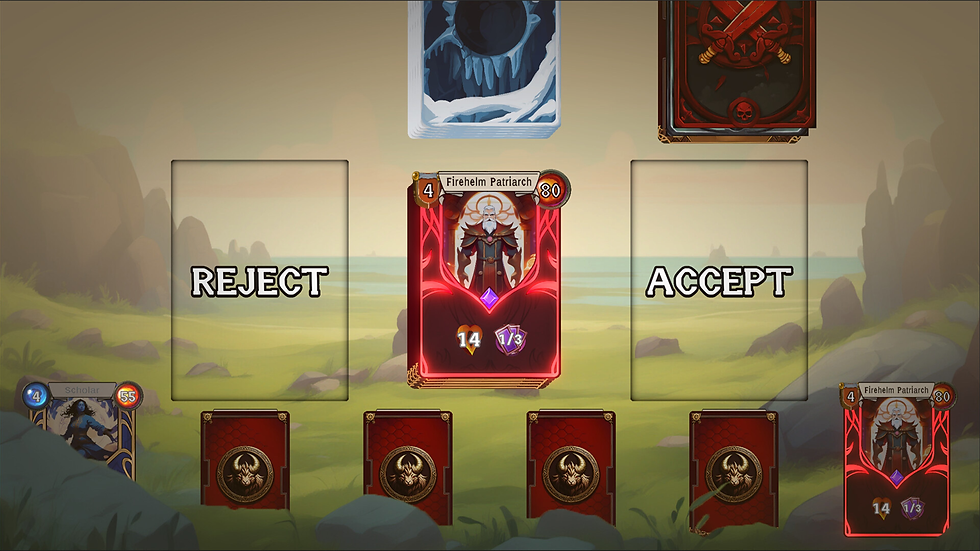
The four playable characters genuinely shift the experience. Their card sets feel distinct, not just reskinned variations. One leans into risk‑reward, another into defensive scaling, another into combo‑heavy synergies. It keeps the game fresh long after your first few deaths.
The swipe‑only control scheme is surprisingly satisfying on a controller. It’s snappy, responsive, and perfect for quick runs, the kind you tell yourself will take five minutes and then suddenly it’s 2am.
Progression in Mori Carta is all about expanding possibility rather than stacking permanent power. Each run feeds into the next by unlocking new cards, new encounters, and eventually new characters, but the game never lets you brute‑force your way through with raw stats. Instead, it widens the sandbox. The more you play, the more the card pool mutates as new mechanics appear, new synergies become viable, and previously impossible builds suddenly click into place. It’s a roguelike that grows sideways, not upward.

Between runs, you’re drip‑fed unlocks tied to milestones: defeating certain enemy types, surviving long enough, discovering specific card interactions, or completing character‑specific challenges. These unlocks don’t make you stronger so much as they make the game stranger. A new curse type, a new buff archetype, a new event chain, each one subtly shifts the meta and nudges you toward experimenting with different swipe decisions. It’s progression that rewards curiosity more than mastery.
Character progression is the most tangible layer. Each of the four protagonists has their own card set and mechanical identity, and unlocking them meaningfully changes how you approach the game. One thrives on risk, another on scaling defence, another on combo loops. As you learn their rhythms, you start to see the card pool differently, the same card that was useless on one character becomes a run‑defining engine on another.

The real arc, though, is player‑driven. You progress by learning the language of the cards, recognising patterns, and understanding how a single left‑or‑right choice can snowball into a build. It’s a roguelike that quietly teaches you to think in probabilities, synergies, and consequences. The more you internalise that, the deeper the game becomes.
This is a roguelike that expects you to die. A lot. But the progression curve is fair, and the unlocks come at a steady pace. Runs feel meaningfully different thanks to the card variety, and the game avoids the trap of forcing you into the same meta‑build every time.
If you enjoy experimenting, you’ll thrive. If you want a tightly curated, designer‑crafted arc… this is more of a sandbox.

Pros
Brilliantly simple swipe‑based deckbuilding — fast, intuitive, and perfect for short or late‑night runs.
Huge card pool (1,000+ cards) that keeps runs feeling unpredictable and encourages experimentation.
Distinct playable characters with genuinely different mechanics and build identities.
High replayability thanks to the sheer variety of enemies, events, and card interactions.
Smooth Xbox optimisation with fast loading, crisp UI, and stable performance.
Progression that expands the sandbox rather than overpowering the player, keeping the challenge intact.
Surprising build synergies that reward curiosity and risk‑taking.
Cons
Visuals are functional rather than atmospheric, lacking the flair of other modern deckbuilders.
Story elements feel light, more flavour text than meaningful narrative.
Repetition creeps in during long sessions, especially with certain enemy/event patterns.
Binary left/right choice system can occasionally feel restrictive when you want more granular control.
Some unlocks feel slow‑burn, especially if you’re chasing specific card types or character milestones.

Mori Carta is a clever, compact roguelike that strips deckbuilding down to its barest inputs without losing the genre’s strategic depth. It’s not the most atmospheric or narratively rich card game on Xbox, but its mechanical hook is strong enough to carry it.
If you love roguelites, deckbuilders, or anything that lets you break a system over your knee with a ridiculous build, this is absolutely worth your time.
XPN Rating: 4 out of 5 (GOLD)

Mori Carta is available now!


Comments