
Kalanoro Review (Xbox Series X|S)


In a gaming landscape overflowing with familiar fantasy worlds and recycled myths, Kalanoro immediately stands out. Developed by Madagascar-based Red Raketa Studio, this colourful action-adventure takes players to the island of Lemuria, a world inspired by Malagasy folklore, music, and culture. Rather than simply borrowing aesthetic inspiration, the game builds its entire identity around these influences, creating an adventure that feels genuinely fresh.
What makes Kalanoro special isn't just its setting. It's the way it combines platforming, light RPG progression, fast-paced combat, band management mechanics, and an endearingly ridiculous narrative about saving an island from an evil witch through the power of music. On paper, that sounds chaotic. In practice, it's charmingly unique.

The story follows Kalakely, a young Kalanoro, a mythical creature drawn from Malagasy folklore. Lemuria was once a thriving paradise before the witch Raneny seized control. Now she's organising a massive concert designed to further cement her influence over the island's inhabitants. The solution? Recruit legendary lemur musicians, form the greatest band in the land, build a following, and bring the fight directly to her stage.
It's an absurd premise, but the game leans into its humour and optimism. Rather than pursuing dark fantasy clichés, Kalanoro maintains an upbeat, adventurous tone throughout. The characters are eccentric, the dialogue is playful, and even the villains possess a theatrical energy that keeps the experience light-hearted. More importantly, the story provides a genuine sense of momentum. Every rescued musician expands your travelling entourage, giving tangible meaning to progression beyond simple stat increases or new abilities.

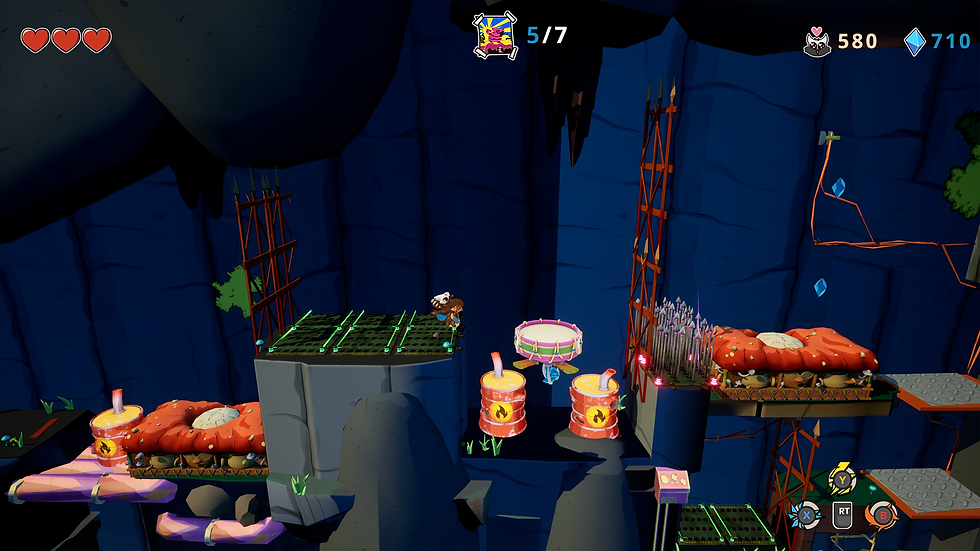
At its core, Kalanoro is an action-platformer. Players traverse a variety of biomes throughout Lemuria, navigating industrial obstacles, environmental hazards, and increasingly demanding movement challenges. Kalakely's small stature translates into quick, agile movement. Levels are designed around constant motion, encouraging players to dash, leap, and weave through danger rather than cautiously inch forward.
The platforming strikes a satisfying balance between accessibility and challenge. It rarely reaches punishing precision-platformer territory, but it demands enough attention to keep traversal engaging. The game's industrial traps provide consistent variety, and later stages cleverly combine combat encounters with movement-based challenges. The result is an adventure that avoids feeling repetitive despite drawing from familiar action-platforming foundations.

If traversing a fantasy island wasn't unusual enough, Kalakely's primary combat ability revolves around mystical hair-based powers. Yes, really. Combat combines these supernatural attacks with improvised weapons found throughout the world, including the wonderfully absurd use of everyday objects like slippers.
What initially sounds like a novelty mechanic actually works well because it reflects the game's quirky personality. Battles move quickly, with enemies encouraging aggressive play and constant movement. Rather than relying purely on combos or intricate systems, combat focuses on maintaining momentum and adapting to different encounter types.

Boss fights are particularly memorable. Designed as larger-than-life spectacles, they blend the game's musical themes with its combat mechanics, producing encounters that feel distinct from standard action-adventure fare. While combat doesn't reach the depth of genre leaders, it remains consistently entertaining thanks to its creativity and high-energy presentation.
The game's most distinctive feature sits between major levels. As Kalakely rescues musicians around the island, players gradually assemble a travelling band of eccentric lemur artists. Between adventures, your taxi-brousse serves as a mobile headquarters where you manage relationships, prepare meals, play mini-games, and keep your growing crew happy.
This system could easily have become a shallow distraction, but it provides much of the game's emotional heart. The musicians feel like more than collectibles. Building friendships with them adds personality to the journey and creates a sense of ownership over your band's success.

The popularity system also creates an enjoyable progression loop. Recruiting performers expands your opportunities, which leads to larger performances and greater influence throughout Lemuria. It's not a deep management simulator, but it gives players a welcome break from combat while reinforcing the game's central themes.
Perhaps the biggest achievement of Kalanoro is its cultural identity. Games inspired by Malagasy folklore remain exceptionally rare, making Kalanoro feel refreshingly different from the fantasy settings players encounter year after year. Lemuria bursts with colour, personality, and artistic flair while remaining rooted in influences seldom explored in mainstream gaming.

The world design, creature concepts, music-focused narrative, and vibrant visual direction all contribute to an atmosphere unlike anything else currently available on Xbox. Even when individual mechanics feel familiar, the cultural lens through which they're presented helps elevate the entire package.
Visually, Kalanoro embraces a bright, stylised presentation. The colourful environments and expressive character designs complement the game's upbeat tone perfectly. Lemuria feels alive, bustling with strange creatures, quirky locals, and imaginative architecture.

The game is optimised for Xbox Series X|S and supports features including 4K Ultra HD, VRR, and 60fps+ performance options. While it may not push hardware in the way blockbuster releases do, its strong art direction often proves more memorable than raw technical spectacle.
Given the game's focus on musicians and performance culture, the soundtrack carries enormous responsibility. Thankfully, the music succeeds in becoming more than simple background accompaniment. The soundtrack helps shape Lemuria's identity and reinforces the game's themes of creativity, community, and resistance. Every new musician recruited strengthens the feeling that you're assembling something larger than yourself. It's one of those rare games where the music feels woven directly into the adventure rather than layered on top of it.
Pros
Beautiful world inspired by Malagasy folklore
Distinctive band-building progression system
Fast, accessible platforming and combat
Charming cast of musicians and characters
Excellent sense of personality throughout
Memorable artistic direction
Cons
Combat can feel simplistic compared to dedicated action games
Management systems may be too light for simulation fans
Some platforming ideas are more familiar than innovative

Kalanoro is one of those indie games that feels genuinely personal. Its blend of action-platforming, quirky combat, band management, and folklore-inspired storytelling creates an experience unlike anything else currently available on Xbox.
Not every mechanic reaches maximum depth, and players looking for highly technical combat or expansive RPG systems may find it relatively straightforward. However, what Kalanoro lacks in complexity, it more than compensates for with heart, creativity, and cultural authenticity. The result is a joyful adventure that celebrates community, music, and mythology while delivering a consistently entertaining journey from beginning to end.
XPN Rating: 4 out of 5 (GOLD)

Kalanoro is available now!


Comments