
Dread Delusion - Review - Xbox
- XPN Network

- Apr 7
- 4 min read

Dread Delusion arrives on Xbox as a rare thing: an RPG that feels genuinely unmoored from modern design habits. It’s not interested in breadcrumb trails, checklist busywork, or combat arenas. Instead, it wants you lost, and I mean gloriously, deliberately lost in a world where every floating island hides a secret, every conversation can tilt the future, and every decision feels like it might come back to haunt you.
This is a game built on vibes, but those vibes have teeth.
Dread Delusion takes place in the Oneiric Isles, a chain of floating islands suspended above a dead, poisoned world. Long ago, a cataclysm shattered the land and forced humanity into the sky. The remnants of civilisation cling to these islands, each ruled by its own ideology, superstition, or decaying power structure. The world isn’t on the brink of collapse. oh no it’s past that point. You’re navigating the aftermath.
You begin as a prisoner conscripted by the Sanctum, a powerful religious authority that claims to protect the Isles from chaos. They send you on a mission to track down a dangerous figure whose actions could destabilise what little order remains.
But the Sanctum’s motives are murky. Everyone’s motives are murky. The game never treats you as a chosen hero, you’re a wildcard dropped into a political powder keg.

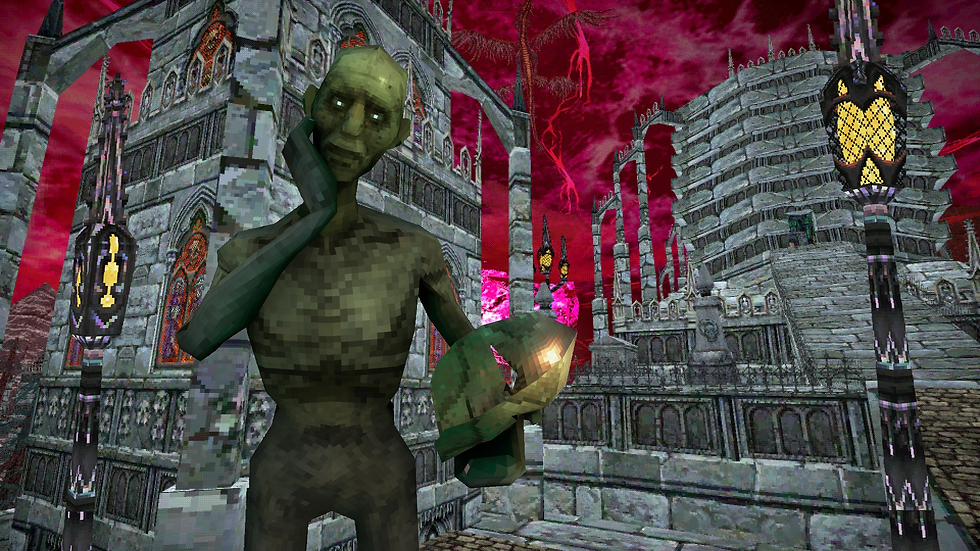
The Oneiric Isles are a fractured archipelago suspended above a poisoned world, and exploring them on Xbox feels like stepping into a fever dream rendered through a PS1 lens. The low-fi textures and angular geometry aren’t a gimmick, they’re a mood. They make the world feel uncanny, ancient, and unstable, like it might collapse if you stare too hard at the horizon.
But beneath the retro aesthetic is a surprisingly modern sense of scale. Towns bustle with strange characters, each with their own agendas. Regions feel distinct: fungal villages, rusted industrial ruins, clockwork kingdoms, and eerie academies that seem to exist slightly out of phase with reality.
The Xbox version runs smoothly, with only occasional hitches during heavy streaming moments. The art direction does most of the heavy lifting, and it shines.

Where most RPGs drown you in numbers, Dread Delusion gives you four core attributes — Might, Guile, Wisdom, and Persona and builds the entire game around them. It’s a bold, elegant system that makes every upgrade meaningful.
Might lets you hit harder or smash through obstacles.
Guile turns you into a lockpicking, sprinting shadow.
Wisdom opens magical routes and lore puzzles.
Persona lets you charm your way into (or out of) trouble.
What makes this work is how often the game lets you use these attributes instead of fighting. Locked door? Pick it. Guard in the way? Charm them. Dangerous route? Solve a puzzle instead of swinging a sword. Combat exists, but it’s never the point and that’s refreshing.

There are no quest markers. No glowing trails. No minimap nagging you. Instead, NPCs give you verbal directions, road signs point the way, and you can buy a compass if you need one. It’s liberating.
Better yet, you can become a cartographer. Equip a mapping book, mark landmarks yourself, and slowly build your own understanding of the world. It feels like reclaiming an old-school sense of adventure, the kind where getting lost is part of the story.

The world runs on a day-night cycle governed by a bizarre neuron-like star. Shops close. Towns sleep. Shadows stretch. Sometimes this is inconvenient; sometimes it’s an opportunity. Burglary, after all, is easier when everyone’s snoring.
But the real weight of time comes from the quests. Each region has a major storyline that can shift the balance of power, and your choices ripple outward. The endings, and there are many reflect the sum of your decisions, not just the final one. The game remembers what you do, even when you think no one is watching.
Dread Delusion’s crafting system is simple but satisfying. You can:
Upgrade armour and clothing to boost specific skills
Mine ore to improve weapons
Brew potions from herbs with unsettling names
It’s all optional, but it feeds beautifully into the game’s build-driven approach. Want to be a silver-tongued wanderer who never draws a blade? Go for it. Prefer smashing doors and enemies alike? Also valid.
Late in the game, you can buy and pilot your own airship. It’s not just a vehicle, it’s a full on statement. You can fly anywhere, land anywhere, and customise the ship’s look. It turns traversal into a pleasure rather than a chore, and it fits the world’s dreamlike tone perfectly.

Pros
A uniquely atmospheric world — The PS1‑inspired visuals and dreamlike sky‑islands create a mood that’s eerie, imaginative, and unlike anything else on Xbox.
Meaningful player choice — Four core stats shape how you solve problems, opening up non‑combat paths that feel genuinely empowering.
Exploration that rewards curiosity — No quest markers, no handholding; the world trusts you to navigate, discover, and get deliciously lost.
Strong quest writing — Factions, characters, and regional storylines offer moral ambiguity and consequences that actually matter.
Flexible builds — Whether you want to be a silver‑tongued wanderer, a stealthy thief, or a blunt-force bruiser, the game supports it.
Satisfying progression systems — Crafting, upgrading, and skill boosts feel purposeful rather than bloated.
The airship — A late‑game traversal tool that feels earned, stylish, and genuinely fun to use.
Runs well on Xbox — Stable performance with only minor streaming hiccups.
Cons
Combat is the weakest pillar — Functional but clunky, especially compared to the strength of exploration and dialogue.
Navigation can frustrate some players — The lack of markers is a feature, but it may feel disorienting if you’re used to modern conveniences.
Occasional visual hitches — Streaming stutters and pop‑in can break immersion in certain areas.
Sparse tutorials — The game expects you to figure things out on your own, which can be thrilling or confusing depending on your playstyle.
Some quests are easy to miss — The open structure means you might wander past content without realising it.

Dread Delusion on Xbox is a strange, singular RPG, a world of floating ruins, occult secrets, and meaningful choices wrapped in a retro aesthetic that hides surprising depth. It’s not for players who want constant combat or modern conveniences, but for those who crave exploration, atmosphere, and consequence, it’s one of the most distinctive RPGs on the platform. It’s a game that trusts you to pay attention. To get lost. To make mistakes. To shape a world that’s already falling apart. And in that trust, it finds something magical.
XPN Rating: 4 out of 5 (GOLD)

Dread Delusion is available now!


Comments