
Death Howl Review – Surviving the Spirit World One Card at a Time


Death Howl opens with a premise that hits like a punch to the ribs: Ro, a mother unwilling to accept her son’s death, steps into the spirit realm to drag him back. On Xbox, that emotional core lands hard thanks to crisp visuals, moody lighting, and a soundtrack that hums with dread. But the game never lets that grief sit quietly, it weaponizes it, turning every encounter into a test of resolve.
This is a deckbuilder, yes. It’s also a grid‑based tactics game. And a Soulslike. And somehow, it works.
The gameplay in Death Howl unfolds as a tense, methodical dance where every decision feels weighted with consequence. Battles take place on compact grids, and the moment you step into one, the game demands your full attention. Positioning becomes a kind of language, shifting a single tile to the left can mean the difference between threading a perfect attack line or getting flattened by an enemy’s sweeping strike. Nothing happens by accident. Every move, every card you play, every space you occupy is part of a slow, deliberate puzzle that punishes hesitation and rewards foresight.
Your deck is the beating heart of the experience, but it’s not something you sculpt into a perfect, unchanging machine. Instead, it’s a restless creature that evolves constantly as you move between regions. Each area has its own card pool, and the game makes sure you feel that shift. Cards from outside the region become more expensive, nudging you to rebuild your strategy again and again. It’s a system that refuses to let you get comfortable. You’re always tinkering, always adjusting, always trying to find the rhythm that will carry you through the next encounter. When it clicks, it’s exhilarating and a moment where your movement, attacks, and defensive options flow together in a way that feels almost musical.
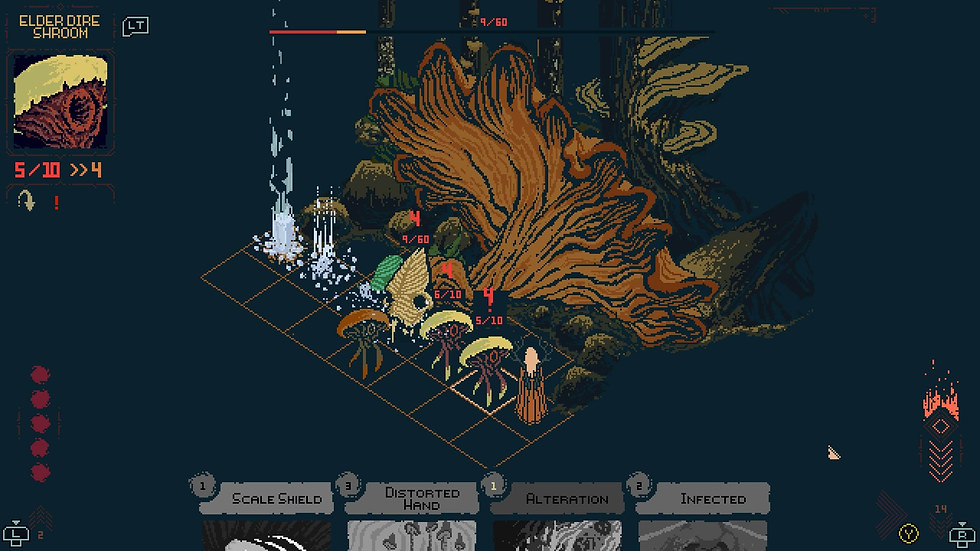
Outside of combat, the world itself plays a huge role in shaping how you approach each run. Death Howl’s open structure means you can wander freely, but that freedom comes with risk. Sacred Groves offer a moment of safety, a chance to rest or upgrade, but using them resets the world around you. Side quests tempt you with rewards but slip extra cards into your deck and even disable fast travel, turning what should be a simple errand into a strategic commitment. And then there are the howls, the resource you drop when you die. Losing them stings, but retrieving them mid‑battle, especially when an enemy has picked them up and grown stronger, creates some of the game’s most intense moments.
Boss fights bring all of these systems together in spectacular fashion. They’re towering, surreal creatures that dominate the arena, forcing you to read their patterns, adapt your deck, and stay one step ahead. These encounters feel like emotional peaks as much as mechanical ones, tying Ro’s grief and determination directly into the challenge in front of you. When you finally bring one down, it feels like you’ve pushed through something heavy and not just a fight, but a moment of catharsis.

The overall difficulty is unapologetic. Death Howl expects you to fail, learn, rebuild, and try again. But that’s also where its magic lies. The game’s systems interlock in a way that makes every victory feel earned, every setback meaningful, and every breakthrough deeply satisfying. It’s a game that asks a lot, but gives back just as much.
Death Howl’s world is open, letting you wander between regions in any order. Each area has its own visual identity, shadowy woods, sun‑bleached deserts, river‑cut canyons and the transitions between them feel seamless.
Totems scattered around the world add passive bonuses with trade‑offs, like extra mana at the cost of clogging your deck with junk cards. Sacred Groves act as rest points, fast‑travel hubs, and upgrade stations, but using them resets enemies. The game constantly asks: Do you want safety, or progress?
Side quests add flavour, but they come with a twist: accepting one adds a quest card to your deck and disables fast travel. It’s a clever idea, though sometimes it feels like busywork.

At its core, Death Howl is a tale about grief, not the soft, cinematic kind, but the raw, disorienting version that makes the world feel slightly wrong around the edges. The game opens with Ro, a mother who refuses to accept the death of her son, stepping into the spirit realm in a desperate attempt to bring him back. It’s not framed as heroism. It’s not framed as madness. It’s simply a human response to unbearable loss, and the game treats that emotional wound with a surprising amount of restraint.
The spirit world Ro enters isn’t a mystical paradise or a nightmare hellscape. It’s something in between, a place shaped by memory, regret, and the echoes of unfinished lives. The environments feel like they’re caught mid‑breath, half‑formed and half‑remembered, as if the world itself is grieving alongside her. Spirits mutter fragments of their pasts, landscapes shift in ways that feel symbolic rather than literal, and the entire journey takes on the tone of a fever dream you can’t quite wake from.
What makes the story compelling is how quietly it unfolds. There are no long monologues or lore dumps. Instead, the narrative seeps in through atmosphere, through the way enemies are designed, through the strange rituals scattered across the world, and through Ro’s own weary determination. You learn about her not because she tells you who she is, but because the world reacts to her, sometimes with hostility, sometimes with pity, sometimes with a kind of resigned recognition.

As Ro pushes deeper into the spirit realm, the game starts to blur the line between her mission and her motivation. Is she rescuing her son, or is she refusing to let go? Is she fighting monsters, or manifestations of her own guilt? The game never answers these questions outright, but it plants them like seeds, letting them grow in the back of your mind as the journey becomes stranger and more emotionally charged.
The bosses, in particular, feel like narrative punctuation marks. Each one reflects a different facet of Ro’s internal struggle like fear, denial, anger, acceptance, without ever spelling it out. When you defeat them, it doesn’t feel like conquering an enemy. It feels like confronting something you’ve been avoiding.
By the time the story reaches its final stretch, Death Howl has quietly built a portrait of a woman wrestling with the impossible: the desire to undo the irreversible. It’s a story that doesn’t rely on twists or spectacle. Instead, it lingers. It sits with you. It asks you to consider what you would do in Ro’s place, and whether the cost of her journey is worth the hope that drives it.

Pros
A powerful emotional core, with Ro’s grief shaping the entire journey in subtle, affecting ways.
Tense, tactical combat that makes every movement and card choice feel meaningful.
A dynamic deckbuilding system that pushes constant experimentation instead of letting you settle into one build.
Atmospheric world design, with regions that feel distinct, eerie, and symbolically tied to the story.
Strong Xbox performance, with smooth framerates and fast loading that keep the pace tight despite frequent deaths.
Memorable boss encounters that blend mechanical challenge with thematic weight.
Cons
Steep difficulty spikes that can feel punishing rather than motivating.
Heavy reliance on grinding to unlock cards and upgrades, which slows early progression.
Quest cards disabling fast travel can make exploration feel more restrictive than rewarding.
UI readability issues, especially when parsing card text during fast decision‑making.
Deckbuilding friction when moving between regions, which some players may find more tedious than refreshing.

Death Howl is harsh, unyielding, and sometimes downright exhausting, but it’s also strikingly confident in what it wants to be. The blend of tactical combat, shifting deckbuilding, and open‑world exploration creates a rhythm that’s unlike anything else on Xbox right now — a rhythm built on tension, adaptation, and the quiet ache of Ro’s grief.
It’s not a game that tries to please everyone. It asks you to sit with discomfort, to rebuild after failure, to accept that progress often comes at a cost. But that’s also what makes it special. Beneath the difficulty spikes and the occasional mechanical friction lies a deeply human story wrapped in a world that feels both haunted and alive. When everything comes together, when your deck sings, when a boss finally falls, when the spirit realm opens up in some new, uncanny way, Death Howl becomes something rare: a game that feels personal.
It’s flawed, yes, but it’s also fearless. And that combination makes it easy to recommend to anyone willing to embrace its strange, sorrow‑soaked journey.
XPN Rating: 4 out of 5 (GOLD)

Death Howl is available now!


Comments