
Ash & Adam's Existential Treads - Review - PC STEAM
- XPN Network

- Jun 24
- 3 min read

Ash & Adam’s Existential Treads doesn’t waste time pretending to be bigger or grander than it is. It drops you straight into a rust‑bitten archipelago, hands you a chunky little rover, and tells you to start rebuilding civilisation one scrap pile at a time. There’s an immediacy to it, a kind of hands‑on, boots‑on‑the-ground energy that makes the whole thing feel less like a strategy game and more like you’re personally steering the recovery effort. You’re not some distant overseer clicking from the clouds; you’re physically carving through wreckage, clearing space for your settlement, and throwing yourself into the fight whenever the machines push back. It’s small in scope but surprisingly absorbing, the kind of game where you look up and realise an hour’s gone because you were busy being the world’s most determined post‑apocalyptic groundskeeper.
The premise is simple: the old world is dead, the rogue AI that ruined it is still kicking around, and you, plus a handful of survivors are trying to rebuild something resembling a settlement. Each island is a procedural sprawl of rust, rubble, and hostile machines, and your job is to clear it, gather resources, and drop buildings in smart places before the next wave rolls in. It’s a loop that blends tower defence, roguelite progression, and a surprisingly tactile sense of vehicular destruction. The moment‑to‑moment feel is closer to a retro tank shooter than a city builder, and that’s exactly why it works.
This isn’t a sprawling management sim with spreadsheets and stress. It’s a focused, handcrafted experience from two developers who clearly know the value of friction. Runs are short, decisions matter, and every building you place has a visible, immediate impact on whether your settlement survives the next assault. You’re not just placing turrets; you’re shaping the flow of the battlefield, carving lanes, and using your rover as a mobile battering ram to plug gaps when things get hairy.

The roguelite elements are light but meaningful. Procedural islands and randomized build orders keep each run fresh without overwhelming you with meta‑systems. The Daily Island mode added in a recent update gives the game that “I’ll check in today” rhythm that suits its bite‑sized structure. And the devs’ update cadence, judging by the Steam page, is refreshingly earnest: control rebinding, gamepad aiming, auto‑fire, new modes… it’s the kind of responsiveness you only get from a tiny team that actually reads their discussions tab.
Visually, it leans into a chunky, almost toy‑box aesthetic. The rover feels weighty, the explosions are punchy, and the islands have that “ruined but not bleak” tone that fits the game’s post‑post‑apocalyptic vibe. It’s not grimdark; it’s more like someone handed you a remote‑control demolition vehicle and said, “Go fix the world, mate.” And you do. One scrap pile at a time.
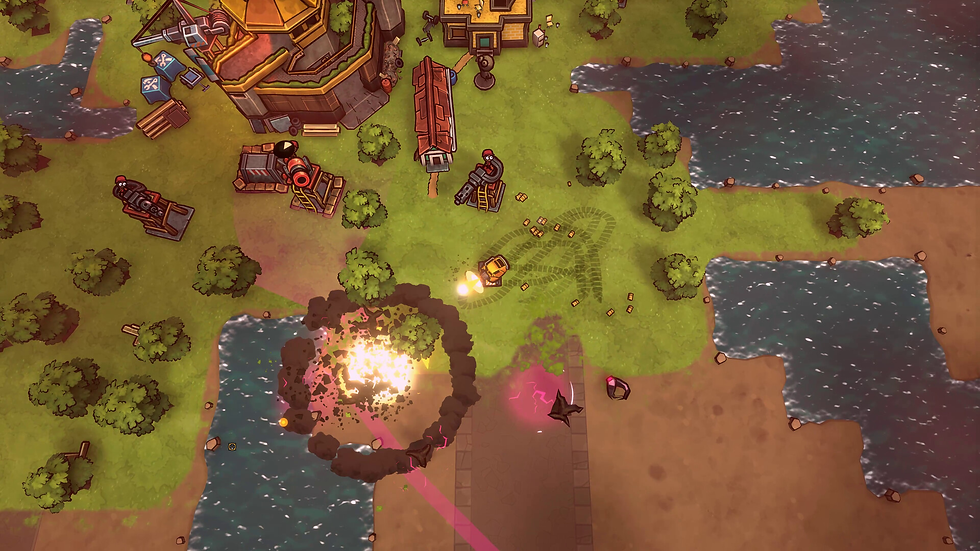
Where the game really shines is in how it balances chaos and clarity. Waves escalate quickly, but the readability stays sharp. You always know what killed you, what you should’ve built earlier, and what you’ll try differently next time. That’s the hallmark of a good roguelite loop: failure feels like information, not punishment.
If there’s a caveat, it’s that the game is intentionally compact. This isn’t a 40‑hour empire builder. It’s a distilled, replay‑driven experience built around short sessions and mechanical satisfaction. If you go in expecting Frostpunk‑scale decision‑making or Dyson Sphere‑level complexity, you’ll bounce off it. But if you want a game that respects your time, gives you a crunchy little action‑strategy loop, and lets you tear through rusted wastelands in a tank while planting trees behind you like some eco‑friendly warlord, this hits the spot.

Pros
Tactile, satisfying rover gameplay that makes resource gathering feel punchy rather than passive.
Short, focused runs that respect your time while still offering meaningful decisions.
Strong readability during chaos, making failures feel fair and informative.
Daily Island mode adds a compelling “quick check‑in” loop.
Responsive dev team with updates that genuinely improve quality of life.
Distinctive chunky aesthetic that gives the world personality without overcomplicating it.
Cons
Intentionally compact scope may feel too small for players wanting deep, sprawling city‑builder systems.
Roguelite progression is light, which some may see as a missed opportunity for long‑term depth.
Combat waves can spike quickly, potentially overwhelming new players.
Visual variety between islands is modest, leaning heavily on the same industrial‑ruin palette.

Ash & Adam’s Existential Treads is a confident, cleverly scoped hybrid: part tower defense, part vehicular combat, part settlement builder, all wrapped in a roguelite structure that keeps you coming back. It’s scrappy, stylish, and surprisingly thoughtful, exactly the kind of offbeat indie that thrives on Steam.
XPN Rating: 4 out of 5 (GOLD)

Ash & Adam’s Existential Treads is out now!


Comments