
Magic Forge Tycoon - Review


Magic Forge Tycoon is a charming, sometimes chaotic fantasy‑management sim that drops you into the role of an apprentice blacksmith learning the ropes under the watchful eye of the Korendor Blacksmith’s Guild. From the very first moments, the game leans into its whimsical worldbuilding: floating islands, expressive characters, and a magical town suspended above the clouds. It’s a setting that feels warm and inviting, and it gives the impression of a living world even though most of your time is spent navigating menus, sliders, and crafting screens. The art direction does a lot of heavy lifting, colourful, readable, and full of personality, making the day‑to‑day grind of forging feel more tactile than it actually is.

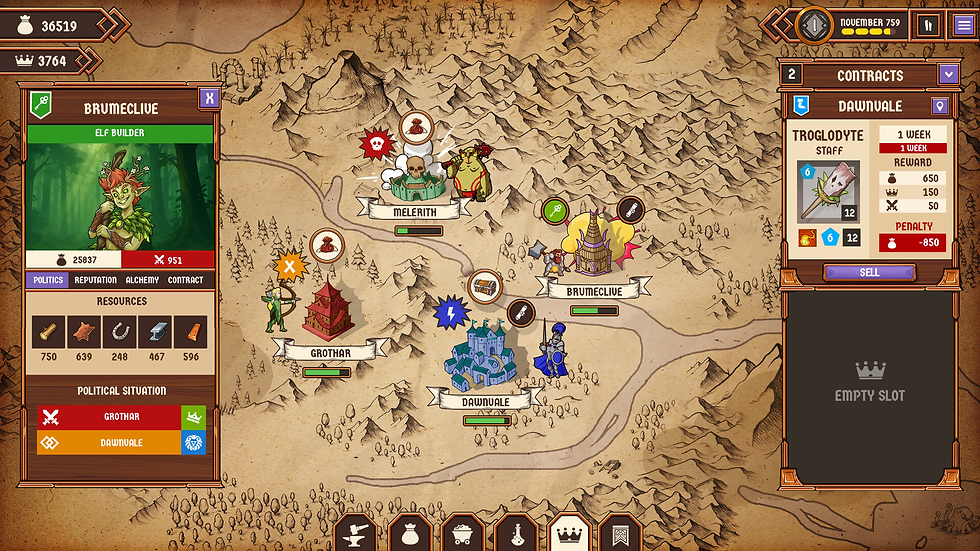
The story is light by design, more of a backdrop than a narrative arc. You’re rebuilding an old workshop into a thriving forge, taking contracts from nobles, factions, and kingdoms whose political fortunes shift based on the weapons you create. The game hints at larger geopolitical consequences like wars breaking out, alliances forming, economies fluctuating, but these elements mostly serve as flavour rather than deeply interactive systems. Still, the idea that your handiwork can tip the balance of power adds a fun layer of fantasy drama to what is otherwise a traditional tycoon loop.
At its core, Magic Forge Tycoon is about crafting enchanted weapons and managing the systems that support that craft. The forging process is hands‑on: you adjust sliders to balance sturdiness, style, magical potency, and other attributes, then refine the weapon through timing‑based minigames and enchantment combinations. When the systems click, it feels satisfying, like you’re genuinely shaping a unique item. But the learning curve is steep. The tutorial is vague, often failing to explain the logic behind the sliders or how to interpret visual clues on weapon templates. Early crafting feels like guesswork, and achieving high‑rated items can feel more like luck than mastery. It takes several runs before the underlying patterns begin to emerge.

Once you push past that onboarding wall, the broader management layer opens up. You gather resources from merchants, stockpile materials to exploit market fluctuations, and upgrade your forge with new technologies that improve efficiency or unlock advanced crafting techniques. As your workshop grows, you hire specialized workers, manage production chains, and juggle contracts that may influence regional politics. The game’s dynamic world means no two runs unfold the same way, wars can disrupt trade routes, factions may demand specific weapon types, and the economy shifts based on scarcity and conflict. This unpredictability gives Magic Forge Tycoon a strong sense of replayability, encouraging experimentation and long‑term planning.
The presentation is a mixed bag. Visually, the game is delightful: crisp UI, expressive characters, and magical environments that make the world feel alive. Performance is solid, with no major technical hiccups. The audio, however, doesn’t quite keep pace. The soundtrack is whimsical but repetitive, looping in ways that become noticeable quickly. Sound effects are serviceable but not memorable, and the lack of voice acting means dialogue relies entirely on text, sometimes faint, sometimes awkwardly phrased, occasionally dotted with typos. These issues don’t break the experience, but they do dull some of the charm.

Magic Forge Tycoon’s biggest hurdle is its onboarding. The game expects players to intuit systems that aren’t clearly explained, and the early hours can feel punishing rather than rewarding. But once the mechanics settle into place, the blend of crafting, management, and light political intrigue becomes engaging. The fantasy setting and visual personality elevate what could have been a dry simulation, and the reactive world keeps each playthrough fresh. It’s not a genre‑defining tycoon game, but it’s a solid, imaginative one, especially for players who enjoy tinkering, experimenting, and slowly mastering a complex system.
Pros
Charming fantasy setting with colourful art and a warm, inviting atmosphere.
Satisfying crafting loop once you understand the systems — forging feels tactile and personal.
Dynamic world events (wars, faction demands, shifting economies) add replayability and unpredictability.
Deep management layer with resource trading, upgrades, worker hiring, and contract juggling.
Strong visual presentation and polished performance.
Cons
Steep learning curve — early hours feel confusing due to vague tutorials and unclear mechanics.
Audio is repetitive, with a soundtrack that loops noticeably and limited sound variety.
Dialogue lacks polish, with occasional awkward phrasing and typos.
Story is light, serving more as flavour than a fully developed narrative.
Crafting success can feel luck‑based until you decipher the underlying systems.

Magic Forge Tycoon ultimately succeeds as a cozy yet ambitious management sim with a distinctive identity. It demands patience, but for those willing to learn its rhythms, it offers a charming world, a satisfying crafting loop, and enough depth to keep you forging for many hours.
XPN Rating: 3.5 out of 5 (SILVER)

Magic Forge Tycoon is available now!


Comments