
LumenTale: Memories of Trey Review


LumenTale: Memories of Trey arrives with the unmistakable energy of a passion project—one built by a team that clearly adores the monster‑collecting genre but isn’t content to simply echo its giants. Set in the richly imagined world of Talea, the game follows Trey, an amnesiac protagonist whose lost memories become the emotional backbone of a journey that blends political tension, ancient history, and the mysterious emotional energy known as Anivis. Talea itself is a standout: a land divided between the technologically advanced north and the more traditional south, each region carrying its own cultural identity, visual flavour, and narrative threads. Even when Trey feels like a familiar archetype, the world around him is vibrant enough to pull you in.
Trey’s story begins with a classic spark: a boy washed ashore with no memories and a strange connection to the emotional energy known as Anivis. But the game quickly pivots from amnesia trope to something more layered. Talea is a land split between tradition and technology, and Trey’s journey threads through that divide as he tries to understand who he is and why he’s able to resonate so strongly with the Animon around him. His lost memories aren’t just a personal mystery, they’re tied to the political tensions simmering across the continent, the ancient history of Anivis, and a shadowy force that seems to be manipulating events from behind the scenes. The story uses that setup to explore themes of identity, emotional connection, and the weight of inherited conflict, all while keeping Trey grounded as a kid trying to make sense of a world that feels both familiar and alien.
As Trey travels, the narrative leans into a gentle, almost wistful tone. Towns and characters offer small, human moments like a craftsman worried about his family, a researcher obsessed with Anivis theory, a rival who’s more lost than antagonistic. These interactions slowly build a picture of Talea’s fractured past and the role Trey unknowingly played in it. The emotional beats land best when the game ties Trey’s rediscovered memories to the creatures he bonds with; Animon aren’t just companions, they’re reflections of the feelings he’s forgotten. By the time the larger conflict comes into focus, the story has shifted from a simple “find your past” quest into something more intimate: a boy learning who he was, who he is now, and who he wants to become in a world that’s still healing from old wounds.

The heart of LumenTale lies in its Animon, the creatures made of Anivis, each tied to emotional attributes that shape their abilities and combat roles. With around 140 species and 13 elemental types, the roster is impressively varied, even if some designs lean toward the visually busy. Catching Animon is an active process: you engage them directly in the field, using your Holoken to attempt captures through quick‑time inputs or by initiating battles. It’s a system that makes exploration feel more tactile, though the timing‑based capture mechanic may be a touch twitchy for some players. Once in battle, the game’s strategic depth becomes clear. LumenTale supports both 1v1 duels and full 4v4 encounters, and its SP/TP resource systems encourage experimentation with team size and ability synergy. Attributes add another layer, small but meaningful modifiers that can reshape how an Animon functions in your lineup.
If Pokémon is the bright, sugary Saturday‑morning cereal of monster‑collecting games, LumenTale: Memories of Trey is the artisanal granola version, still sweet, still comforting, but with a surprising amount of emotional fibre. Pokémon hands you a creature and says, “Go make friends and maybe save the world.” LumenTale hands you a creature and says, “By the way, it’s made of feelings, your feelings might be missing, and also the world might be falling apart emotionally, good luck.”
Where Pokémon has gyms, LumenTale has therapy‑adjacent elemental battles. Where Pokémon has Pikachu, LumenTale has a small emotional gremlin who looks like it crawled out of a dream journal and wants to talk about your childhood. And instead of a professor giving you a starter, LumenTale basically throws you into the sea and says, “Figure out who you are while bonding with sentient mood‑blobs.” It’s familiar, but with just enough existential spice to make you go, “Oh. Oh we’re doing feelings today.”

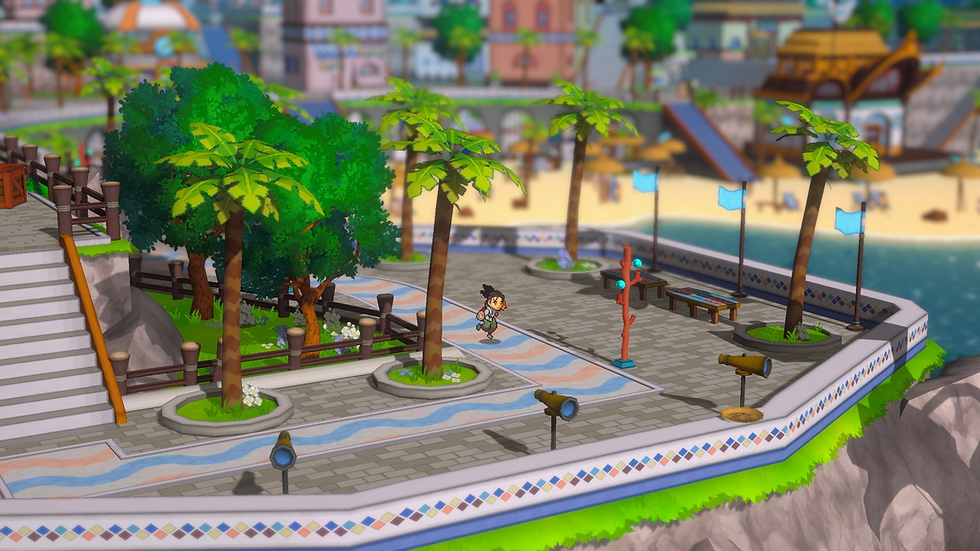
Visually, the game is gorgeous. Its HD‑2D‑inspired presentation blends 3D environments with pixel‑art characters and creatures, resulting in a world that feels warm, handcrafted, and full of personality. Dynamic camera shifts during exploration give Talea a cinematic quality, and the soundtrack elevates nearly every moment with emotional, adventurous, and sometimes unexpectedly moving compositions. It’s clear that Beehive Studios poured a lot of love into the atmosphere, and it pays off.
Where LumenTale shines in world‑building and combat, it stumbles in pacing and onboarding. The early hours feel story‑driven and inviting, but the narrative momentum slows significantly as the game shifts toward long stretches of battling and traversal. Difficulty spikes appear abruptly, sometimes in what still feels like tutorial territory and the game’s explanations of its deeper systems can be sparse. Features like the Anispace, crafting, and certain evolution mechanics are left for players to decipher with minimal guidance, which can be frustrating in a genre where clarity is key. Exploration, too, can feel uneven: some towns are lively and full of character, while others feel oddly empty, with NPCs offering little interaction and side activities that don’t always justify their inclusion.
Yet despite these rough edges, LumenTale remains an undeniably charming experience. Its convenience features like scanning enemies to permanently reveal weaknesses, or instantly defeating low‑level foes show a thoughtful respect for the player’s time. Its combat system rewards creativity. Its world is rich with lore and emotional texture. And its sense of heart is unmistakable. This isn’t a game trying to dethrone Pokémon; it’s a game trying to stand proudly beside it, offering something familiar yet distinct, cozy yet ambitious.

Pros
Gorgeous HD‑2D‑style presentation with warm lighting, detailed environments, and expressive pixel art.
Engaging combat system with 1v1 and 4v4 options, SP/TP resource management, and meaningful team‑building depth.
Large and varied Animon roster (around 140 creatures) with 13 elemental types and emotional‑attribute modifiers.
Tactile exploration and capturing, with active encounters and timing‑based capture mechanics that make the world feel alive.
Strong sense of atmosphere, supported by a heartfelt soundtrack and a world rich with lore and emotional themes.
Player‑friendly conveniences, like scanning enemies to permanently reveal weaknesses and auto‑defeating low‑level foes.
A story with emotional weight, tying Trey’s lost memories to the world’s history and the nature of Anivis.
Cons
Uneven pacing, especially in the mid‑game where story momentum slows and long stretches of combat take over.
Difficulty spikes that appear early and unexpectedly, sometimes before systems are fully explained.
Under‑explained mechanics, leaving features like crafting, evolution paths, and Anispace feeling opaque.
Some towns and NPCs feel sparse, with limited interaction or side content to flesh them out.
Creature designs can be visually busy, making some Animon harder to read at a glance.
Occasional performance dips and minor technical roughness depending on platform.
Story beats can feel familiar, especially early on, before the deeper lore kicks in.
LumenTale: Memories of Trey is a flawed but heartfelt creature‑collecting RPG with gorgeous presentation, clever combat ideas, and a world worth getting lost in. Its pacing issues and under‑explained systems hold it back from greatness, but its charm, atmosphere, and strategic depth make it an easy recommendation for fans of the genre who are willing to embrace a few imperfections along the way.
XPN Rating: 4 out of 5 (GOLD)

LumenTale: Memories of Trey is available now!


Comments