
KAZUMA KANEKO'S TSUKUYOMI - Review - Nintendo Switch
- XPN Network

- May 24
- 5 min read

Tsukuyomi is a strange, compelling, and often conflicted creation, a roguelike deckbuilder wrapped in the aesthetic legacy of one of Japan’s most influential demon artists. It’s a game that constantly pulls you between fascination and frustration, between the allure of Kaneko’s mythic worldbuilding and the lingering seams of its mobile‑game origins. On Nintendo Switch, that tension becomes the heart of the experience: a tower‑climbing ritual that’s equal parts atmospheric, addictive, and uneven.
The story begins with THE HASHIRA, a colossal high‑tech tower in Tokyo suddenly sealed by a supernatural barrier. Inside, the structure has transformed into a chaotic ecosystem of escaped Jinma - demons, gods, and folkloric entities, all threatening the civilians trapped within. The Tsukuyomi, a group of magically empowered agents who channel the moon god’s authority, are dispatched to ascend the tower and uncover the truth behind the ritual unfolding at its peak.
Narratively, the game unfolds in a segmented, almost anthology‑like structure. You play through the tower multiple times, each run from the perspective of a different Tsukuyomi: Izayoi, Shingetsu, Magetsu, Hangetsu, and eventually the unlockable Tomi Noriko. Each protagonist brings their own philosophy, temperament, and mechanical identity, but the story itself is delivered in sparse, symbolic bursts, more Shin Megami Tensei than Persona, more mythic scaffolding than character‑driven drama. The tower becomes the real protagonist: a shifting, oppressive labyrinth where moral choices, deity encounters, and surreal vignettes hint at a larger cosmology of vice, virtue, and nature.
There are moments of genuine thematic spark, encounters that force you into uncomfortable moral territory, or bosses whose designs and mechanics reflect the metaphysics of the world. But the narrative is also fragmented, sometimes feeling like connective tissue between runs rather than a cohesive arc. The mobile‑game DNA shows here: story beats arrive at fixed intervals, and swapping protagonists every few floors can make it difficult to stay emotionally anchored. Still, the atmosphere is potent, and the gnostic undertones give the climb a ritualistic weight.

At its core, Tsukuyomi is a deckbuilder with a distinctive rhythm. You draw three cards at a time, each representing a Jinma under your command. Every action consumes Odo, your energy resource and every card you play immediately draws the next from your deck. The twist is that your deck doesn’t automatically reshuffle; you only refresh it when you end a turn with zero cards remaining. This creates a constant tension between aggression and restraint. Burn through everything too quickly and you’ll start the next turn with a single card. Hold too much back and you risk being overwhelmed.
Mid‑game, you can face and potentially recruit Dante, Nero, and Vergil as powerful Jinma cards. Their abilities mimic their DMC5 styles, adding a wild, stylish twist to the deckbuilding meta. It’s fan‑servicey, but in a way that genuinely enriches the gameplay.
Enemies don’t just attack you, they attack your cards. Each card has a defence value, and if an enemy’s strike exceeds it, the card is destroyed for the rest of the fight. This gives combat a tactile, almost physical feel: your deck isn’t just a resource, it’s your body, and every hit reshapes your options.
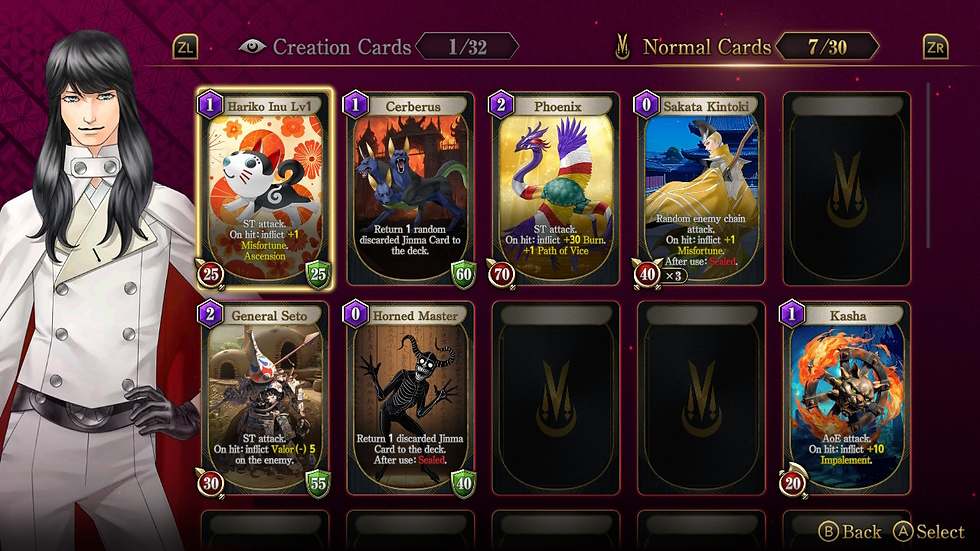
Each Tsukuyomi plays differently. Izayoi is the dependable all‑rounder, Shingetsu builds long Odo‑regenerating combos, Magetsu leans into self‑harm and status effects, Hangetsu blends both extremes, and Tomi Noriko wields boss‑inspired cards that are powerful but demanding. These identities give each run a distinct flavour, and the boss fights, many with unique gimmicks push you to rethink your approach. Some bosses inflict cascading debuffs, others steal your mana, others punish long combo chains. The best encounters feel like puzzles, forcing you to adapt rather than brute‑force.
The game’s most ambitious system is the Creation Cards, powerful, deity‑themed cards gifted by the god Okami. As you explore, your actions accumulate divine attention, eventually triggering a moment where Okami offers to “create” a card for you. You choose from three prompts, each determining the artwork and ability. Once unlocked, these cards persist across future runs, forming a kind of meta‑progression that slowly reshapes your starting deck.
This system is fascinating but also destabilising. Creation Cards are often dramatically stronger than the random demon cards found in dungeons, and because you can handpick them at the start of each run, the roguelike unpredictability gradually erodes. Runs begin to feel similar once you’ve built a stable of optimal cards, and the tension between improvisation and planning tilts heavily toward the latter. It’s a design choice that will delight JRPG fans who enjoy controlled progression but may frustrate roguelike purists who crave chaos.
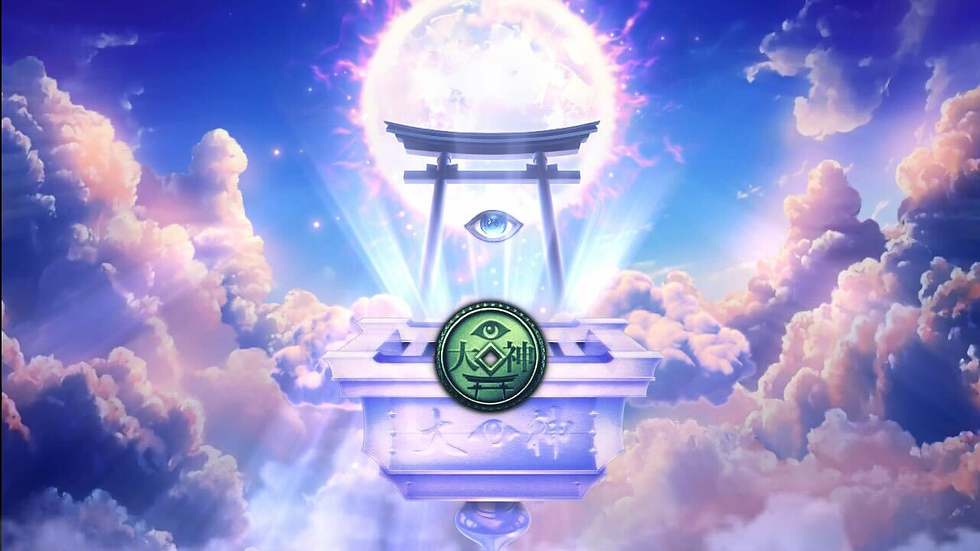
The moral alignment system - Vice, Virtue, and Nature, influences which Creation Cards you can receive, adding a thematic layer to your choices. Many events present ambiguous dilemmas, and the game is at its best when it forces you to weigh power against principle.
These moments hint at a deeper narrative potential that the game only partially realises.
Between battles, you navigate small dungeon maps by choosing branching paths that lead to fights, shops, events, or deity encounters. It’s functional but simple, more a flowchart than a labyrinth. The structure works well enough for quick runs, but it also exposes the game’s mobile roots: progression is steady, predictable, and designed around repeatable loops rather than discovery.
The post‑game HASHIRA Mode introduces more randomness and difficulty, but it also amplifies the game’s balance issues. Some enemies hit far harder than their rank suggests, and certain bosses can hard‑counter entire deck archetypes with no warning. It’s a mode that rewards grinding more than mastery, and while it extends the game’s lifespan, it also highlights the unevenness of its systems.

The most controversial aspect of Tsukuyomi is its art. While some boss designs and hand‑drawn elements carry Kaneko’s unmistakable touch, angular silhouettes, mythic austerity, occult geometry, much of the monster art is AI‑generated, trained on his style. The result is a visual landscape that feels uncanny and inconsistent. Some designs are striking; others are glossy, distorted, or subtly “off,” especially when placed side‑by‑side. The Creation Card art, curated from the mobile version’s AI outputs, varies wildly in quality.
This inconsistency creates a strange dissonance. The worldbuilding is rich, the themes are mythic, the atmosphere is thick with occult tension, yet the visuals often undermine that cohesion. When the art lands, it’s evocative. When it doesn’t, it breaks immersion. The soundtrack, on the other hand, is moody and effective, with battle themes that echo the intensity of classic action‑RPGs.

Pros
Stunning demon and deity designs from Kaneko’s legendary hand
Tight, elegant three‑card combat system
Strong roguelike loop with meaningful progression
Four‑perspective story adds depth and replay value
Atmospheric, myth‑drenched worldbuilding
DMC5 crossover is surprisingly substantial and fun
Runs are quick and addictive, perfect for handheld play
Cons
Story delivery is fragmented — some players may want more traditional cutscenes
Random events can feel swingy
The auto‑movement exploration system may feel too simple for some
Difficulty spikes, especially with optional DMC fights
Visual presentation leans heavily on stills and stylised art rather than full animation

Despite its contradictions, Tsukuyomi is undeniably compelling. The combat system is clever and satisfying, the boss fights are memorable, and the blend of JRPG progression with deckbuilding strategy creates a rhythm that’s easy to sink into for hours. The moral choices, deity encounters, and mythic framing give the game a flavour that stands apart from its genre peers.
But it’s also a game shaped by compromise: mobile‑game remnants, balance quirks, and an art direction caught between human vision and machine approximation. It’s a roguelike that sometimes resists being a roguelike, a JRPG that sometimes feels too skeletal, a Kaneko project that sometimes feels haunted by something that isn’t quite Kaneko. And yet it’s fascinating. It’s memorable. It’s worth playing if you’re drawn to myth, mood, and mechanical experimentation.
XPN Rating: 4 out of 5 (GOLD)

KAZUMA KANEKO'S TSUKUYOMI is available now!


Comments