
Blueberry (Xbox Series X|S) – Review
- XPN Network

- Jun 22
- 4 min read

Blueberry is one of those games that doesn’t so much begin as it quietly sits beside you, waiting for you to notice the weight it’s carrying. It’s a narrative platformer about trauma, generational wounds, and the long, uneven road toward forgiving yourself, but it’s also a cosy, purple‑hued puzzle‑platformer where you steal cookies, fight your mum in Street Fighter‑style “word battles,” and pet cats to reduce your emotional stress. It’s a strange, tender little thing, and on Xbox Series X|S it feels right at home.
This is a game about a woman’s entire life from childhood to old age, refracted through a surreal “Tower of Life” that you climb one memory at a time. Each door is a vignette, each vignette a puzzle piece, and each puzzle piece a shard of a life that’s been cracked, dropped, glued back together, and cracked again.
And somehow, it’s beautiful.

Blueberry opens in the protagonist’s later years: slippers, cardigan, strained phone call with her adult son. The loneliness is immediate, but the surrealism hits even faster, a tiny scuba‑diving creature appears in her bathroom, spitting self‑loathing like a depression gremlin. It’s a bold, almost theatrical introduction to the game’s emotional vocabulary.
From there, you’re pulled into the Tower of Life, where each chapter represents a stage of Blueberry’s life:
Childhood – bright colours, dark corners
The early hours are whimsical: oversized household objects, bouncy music, cookie‑jar heists. But the cracks show quickly, a mother overwhelmed, a father numbing himself, a child internalising everything. Even here, the game’s symbolism is sharp: trees with faces, juice boxes as self‑care, a teddy bear that becomes a towering guilt‑monster.

Teenage Years – rain, rage, and math tests
The palette darkens. The world rains constantly. Blueberry mutters “I hate myself and I want to die,” a gut‑punch of teen angst and Nirvana reference. You dodge literal math‑test hazards, argue with your mother in intense dialogue battles, and watch the heartbreak meter spike as family fractures widen.
Adulthood – motherhood, exhaustion, and echoes of the past
This is where the game hits hardest. Blueberry is pregnant, broke, working a call‑centre job, and trying to be a better parent than the one she had. The platforming becomes frantic, the symbolism heavier, and the emotional stakes sharper. Her son becomes both a source of love and a mirror she’s terrified to look into.
Old Age – reflection, regret, and the slow climb toward peace
Returning to where the game began, you revisit memories with new context. Trauma reframes itself. Choices matter more. The game asks you to guide Blueberry toward healthier responses, not perfectly, but honestly.

Mechanically, Blueberry is simple: 2D platforming, light puzzles, exploration, and dialogue choices. But the simplicity is intentional. The movement has a floaty, dreamlike wobble that suits the mindscape setting. The “Blues” system, an emotional stress bar instead of health is the standout mechanic. Stress spikes during arguments or painful memories, and you lower it through small acts of comfort: juice, treats, quiet moments.
It’s a gentle reminder that healing is built from tiny, deliberate acts.
The game isn’t difficult, in fact, it’s very forgiving but that’s not a flaw. It’s a narrative platformer first, a metaphor second, and a challenge third.
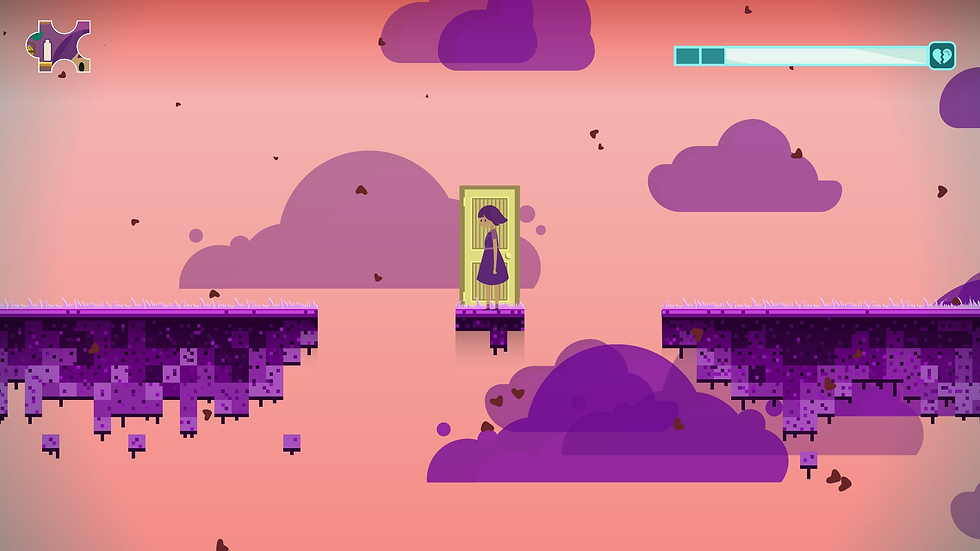
Visually, Blueberry is gorgeous in a scrapbook‑collage way. Purple dominates the palette, shifting from warm to oppressive depending on Blueberry’s emotional state. The world morphs with her mood: bright childhood colours fade into cold surveillance‑eye trees; adulthood becomes cluttered and heavy; old age softens into something bittersweet.
The soundtrack is equally strong, with adaptive audio that swells during emotional peaks. “Pieces of Me,” the vocal track, is a standout moment, the kind of thing that hits you right in the chest.
Blueberry’s biggest missed opportunity is its lack of post‑game reflection. With themes this heavy including depression, suicide, generational trauma, a breakdown of choices or a gentle debrief would’ve been valuable. The game trusts players to interpret their journey, which is admirable, but some may feel unmoored after the credits roll. A little more challenge in the platforming wouldn’t hurt either.

Pros
Beautiful, surreal art direction
Strong emotional storytelling across all life stages
“Blues” system is a brilliant emotional mechanic
Great soundtrack with standout vocal moments
Accessible, forgiving platforming
Short but impactful runtime
Cons
Very little challenge
No post‑game reflection or breakdown of choices
Some may find the emotional themes overwhelming

Blueberry is short at around 2 to 4 hours, but it lingers. It’s tender, surreal, and emotionally literate in a way few games manage. It’s not here to “fix” trauma or offer easy answers. Instead, it gives you a woman’s life in pieces and asks you to help her make sense of it.
On Xbox, it runs smoothly, looks lovely, and feels like the kind of intimate indie experience that stays with you long after you’ve put the controller down.
If you’re drawn to narrative‑driven indies, emotional storytelling, or games that mix cosy aesthetics with heavy themes, Blueberry is absolutely worth your time.
XPN Rating: 4 out of 5 (GOLD)

Blueberry is available now!


Comments