
Baladins (Switch) – A Papercraft Time‑Loop Adventure That Shines in Co‑Op


Baladins on Switch feels like someone took a cozy tabletop one‑shot, flattened the minis into paper cut‑outs, and trapped the whole thing in a six‑week time loop. It’s a combat‑free, co‑op‑first RPG where your job isn’t to slay the dragon so much as entertain it, out‑think it, and maybe, eventually, outgrow it. If that premise already makes you smile, you’re halfway to knowing whether this is your thing.
Baladins wears its inspirations loudly: Paper Mario‑style 2D characters on a 3D board, Baldur’s Gate 3‑adjacent stat checks, and the pacing of a light tabletop campaign rather than a 60‑hour epic. Towns and landmarks sit on a board‑like overworld; you move a little standee across nodes, spend points, trigger vignettes, and roll dice to see how it all shakes out.
You pick from five classes. Cook, Luxomancer, Dancer, Pyro, Bard, each with different stats in physique, finesse, knowledge, creativity, and destruction. Those numbers matter: every encounter is a skill check or a small decision tree, resolved by rolling three six‑sided dice and adding the relevant stat. It’s friendlier than a D20 system; the floor is higher, the variance tighter, and it feels tuned to encourage risk rather than punish it.
On Switch, that board‑game feel actually works in its favour. Short sessions, clear turns, and simple inputs map nicely to handheld play. It’s the kind of game you can boot up on the sofa, run a loop, and put down without feeling like you’ve “lost the thread”.

The structure is simple and clever: you have a limited number of weeks (turns) to prepare for a looming visit from Colobra, a time‑eating dragon. Each in‑game week is a turn where you spend Movement Points to travel and Ability Points to act—talk, train, take on quests, attempt challenges.
At the end of six weeks, Colobra shows up, eats your treasures, rewinds the world, and you start again. Your items mostly vanish; your improved stats and, crucially, your knowledge of the map and quests persist.
This does a few things well:
• Failure becomes texture, not a wall. A bad roll or a mis‑spent week isn’t the end; it’s another branch you’ve now seen.
• The game invites experimentation. You’re not optimising a perfect run so much as poking at the edges of what’s possible in each loop.
• It respects your time. A loop is roughly a short session, ideal for Switch’s pick‑up‑put‑down rhythm.

Baladins is technically fully playable alone, and the Switch version supports both local and online multiplayer. But the design very clearly assumes more than one brain at the table.
With multiple players, you:
Combine stats to clear tougher checks.
Split the map, covering more quests in a single loop.
Turn decisions into little debates, “Do we burn the week on this long‑shot quest or shore up stats?”
In solo play, all of that collapses onto one character. You’re still rolling dice, still nudging stats up, still discovering new quest outcomes but the pace is slower, and the repetition hits harder. You will have the feeling that you are being “punished” for playing alone, and while that’s a bit strong, you can feel the friction: the systems sing when there are two to four of you bouncing ideas and failures around; they hum quietly when it’s just you.

The papercraft aesthetic is a natural fit for the Switch’s hardware. It’s colourful, legible, and stylised enough that you’re not chasing fidelity. The board‑game framing keeps scenes compact, and the UI, while occasionally opaque in terms of information design, is readable in handheld mode.
The Switch version holds up well: stable performance, no major feature cuts, and full support for local and online co‑op. The short‑session structure and turn‑based pacing make it a genuinely comfortable handheld game as you’re never fighting the controls or the screen size.

Pros:
Distinctive papercraft/board‑game aesthetic that looks great on Switch.
Combat‑free, choice‑driven structure that feels welcoming to non‑RPG diehards.
Time‑loop campaign in bite‑sized sessions, perfect for handheld play.
Five varied classes that meaningfully change how you approach quests.
Co‑op focus that captures the feel of a light tabletop night with friends.
Cons:
Repetition is baked in and can become numbing, especially solo.
Clearly tuned for multiplayer; solo runs feel slower and less satisfying.
UI and quest clarity issues can make early hours more confusing than they need to be.
Low narrative stakes and shallow characterisation if you’re craving deep story or emotional arcs.
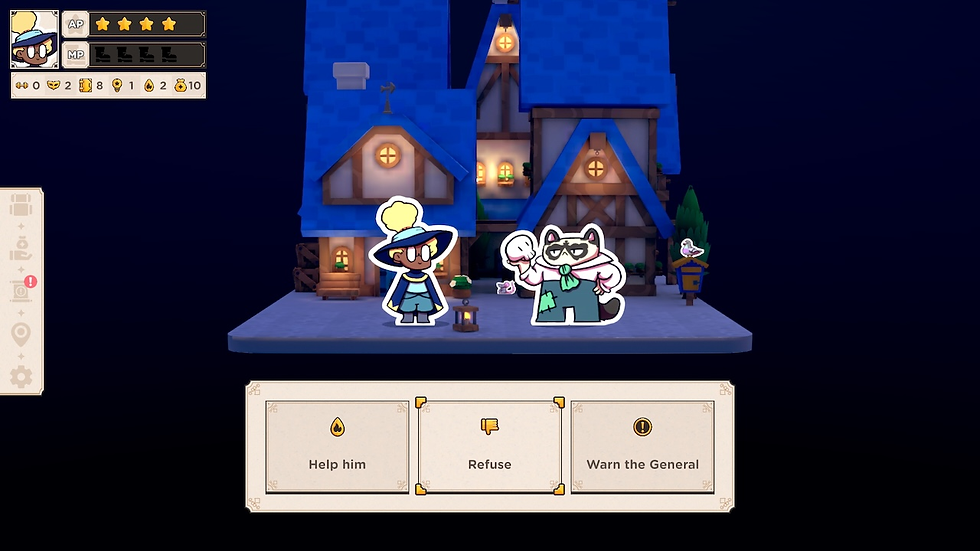
Baladins on Nintendo Switch is a charming, slightly messy little time‑loop RPG that cares more about shared stories than perfect runs. As a solo experience, it’s a cozy, occasionally repetitive board‑game‑in‑a‑box you dip into for a loop or two. As a co‑op game, it comes much closer to something special: a whimsical, low‑pressure campaign where every bad roll and odd choice becomes part of the story you tell later.
If you want crunchy builds, big drama, or a sense of constant forward momentum, this probably isn’t your dragon. But if you like the idea of passing a Switch around, rolling some virtual dice, and seeing what kind of trouble a group of paper Baladins can get into before time snaps back again, it’s an easy one to recommend.
XPN Rating: 3.5 out of 5 (SILVER)

Baladins is available now!


Comments