
Baki Dou: Blood Arena Review — A Stylish, Heavy‑Hitting Brawler for Newcomers and Fans Alike


Baki Dou: Blood Arena is a lean, punch‑drunk 2D fighting game built for fans who want to be Baki Hanma for a few hours, not study frame data or climb ranked ladders. It’s scrappy, exaggerated, and proudly anime‑forward.
Coming in cold, Baki Duo: Blood Arena is a fun, punchy, slightly chaotic brawler that doesn’t demand prior fandom, but it definitely expects it. You can enjoy the fights, the style, and the sheer absurdity of the characters without knowing a single thing about the anime, but you’ll also feel like you’re missing the emotional context that long‑time fans bring with them.
Baki is a long‑running martial‑arts anime and manga franchise created by Keisuke Itagaki. At its core, it follows Baki Hanma, a young fighter whose life goal is to surpass and eventually defeat his father Yujiro Hanma, a man widely regarded as “the strongest creature on Earth.”
The world of Baki is built on one idea: Strength is everything. Baki trains relentlessly from childhood, developing a hybrid style called Total Fighting, blending techniques from many martial arts. His journey is a constant escalation as every time he grows stronger, even more dangerous fighters appear to challenge him.
The game opens with Baki stepping into a brutal underground arena circuit. It's a place where fighters aren’t just skilled, they’re dangerous. This isn’t a tournament with rules; it’s a proving ground. Your first opponents are martial artists with distinct styles and personalities. Each fight is framed as a test of Baki’s growth, not just a random encounter. The game positions every opponent as a “puzzle in flesh,” a challenge you must read, understand, and overcome.

Baki Duo: Blood Arena plays like a series of intense, one‑on‑one showdowns, each designed to feel more like a boss fight than a traditional round‑based match. The entire game revolves around duels, with no crowds of enemies or filler encounters. It's just you and a single, hyper‑focused opponent who wants to test your limits. It’s a stripped‑back structure that suits the game’s personality: direct, confrontational, and dramatic.
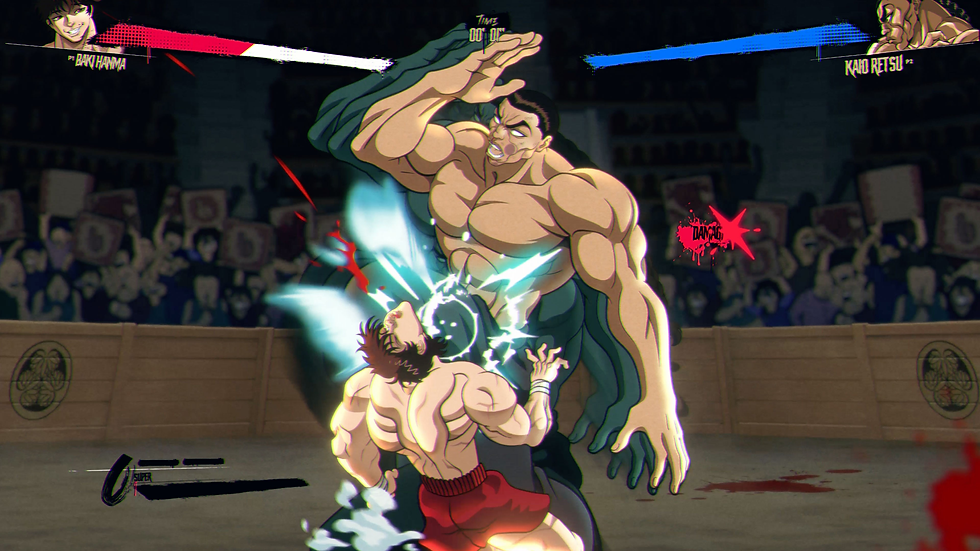
The controls are deliberately simple, built around light, medium, and heavy attacks, along with dodges and a handful of special moves. You’re not expected to memorise complex inputs or juggle long combos. Instead, the game leans into timing, spacing, and reading your opponent’s behaviour. Every strike lands with a heavy, exaggerated impact, complete with chunky sound effects and freeze‑frame moments that make each hit feel like it’s trying to punch its way out of the screen. Movement is deliberate rather than flashy, giving fights a sense of weight and tension like two fighters circling, waiting for the moment to commit.

Each opponent brings their own rhythm and personality to the fight. Some are slow and tank‑like, others are fast and unpredictable, and each one forces you to adjust your approach. You’re not learning a deep system so much as learning how to handle a series of distinct, dangerous individuals. Health bars are long, and fights often turn into endurance matches where momentum can swing dramatically. It’s less about technical mastery and more about surviving a brutal, theatrical slugfest.
The game is entirely single‑player, with no online modes, no competitive ranking, and no progression systems to grind. It feels intentionally old‑school with a curated sequence of fights rather than a platform for long‑term play. That simplicity is part of its charm, though it also means repetition can creep in if you’re looking for mechanical depth.

The game leans heavily into a stylised 2D aesthetic that feels like a manga panel brought to life. Characters are drawn with thick outlines, exaggerated musculature, and dramatic shading that emphasises every flex, grimace, and impact. It’s not aiming for realism at all, it’s aiming for expression. Every punch is framed with bold impact effects, freeze‑frames, and sharp contrast, giving the fights a theatrical, almost comic‑book rhythm.
The animations vary in quality, but when they hit, they hit hard. Some moves have a real sense of weight, with bodies twisting and snapping into poses that feel ripped straight from the anime’s most intense moments. Other animations are a bit stiff or limited, reminding you that this is a smaller‑scale production. Still, the overall visual identity is strong: gritty, muscular, and unapologetically dramatic.
The comparison to Punch‑Out!! in terms of style is surprisingly apt, even though the two games come from very different eras and tones. Both titles focus on one‑on‑one fights, with opponents who have exaggerated personalities and distinct attack patterns. Both rely on reading tells, dodging at the right moment, and punishing openings. And both use stylised visuals to amplify the drama of each encounter.
The Musashi DLC:
Musashi Miyamoto is one of the most iconic figures in the Baki mythos, he's a resurrected swordsman whose presence shifts the tone from “underground martial arts” to “mythic, almost supernatural duel.”
What the DLC Adds
A brand‑new battle inspired by the Baki Dou season
New visuals and animations specifically for this showdown
A high‑stakes, one‑on‑one fight that feels more cinematic than anything in the base game
The Musashi DLC shifts the tone noticeably. Musashi moves faster and hits harder than most of the base‑game roster, and his sword‑based style changes the pacing of the fight. You can’t simply trade blows with him; you have to respect his range and react quickly to his precision attacks. The encounter feels more cinematic and polished, almost like the developers poured extra attention into making this duel stand out. It’s easily the most intense and technically demanding fight in the game, and it gives the experience a sense of climax that the base campaign doesn’t quite reach on its own. It’s clear the developers poured extra love into this one. If the base game is a fun anime brawler, the Musashi DLC is the moment where it becomes a Baki event.

Pros
Strong anime‑faithful presentation
Satisfying, heavy‑impact combat
Great for short sessions
Musashi DLC is a standout encounter
Cloud‑playable and accessible
Cons
Shallow mechanics
Repetitive structure
Uneven animation quality
No multiplayer or long‑term progression

Baki Duo: Blood Arena feels like a love letter to fans , a compact, punchy, no‑nonsense brawler that lets you live out the fantasy of being Baki Hanma. It’s not trying to compete with the giants of the fighting genre; it’s trying to deliver a playable anime showdown, and on that front, it succeeds.
The Musashi DLC is the game’s crown jewel as it's a stylish, intense duel that captures the spirit of Baki Dou better than anything else here. If you’re a fan of the anime or manga, this DLC alone makes the package worth a look.
XPN Rating: 3.5 out of 5 (SILVER)

Baki Dou: Blood Arena is available now!


Comments